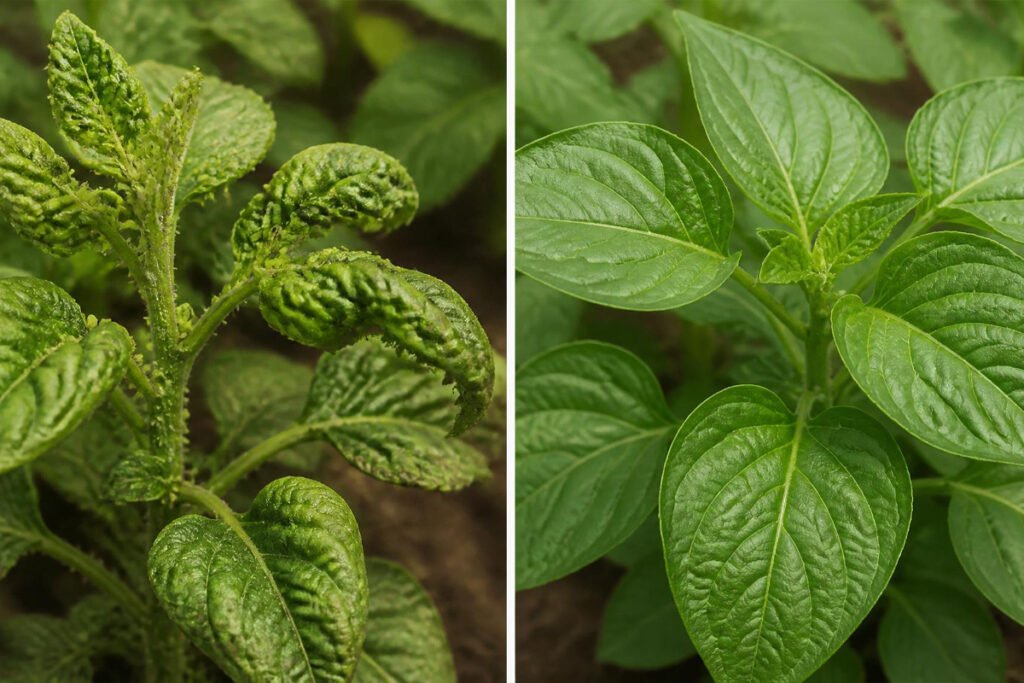
Reaching for a generic “organic pest spray” without knowing which pest you’re actually dealing with is a bit like taking medicine without knowing what’s wrong — it might help by accident, but it’s just as likely to do nothing at all. Aphids, caterpillars, slugs, and flying pests each respond to completely different organic products, and using the wrong one means wasted time, wasted money, and a pest problem that keeps getting worse while you wait for a fix that was never going to work on that particular insect.
The good news is that once you know which pest is actually causing the damage, organic pest control becomes a much more targeted, effective process, the same diagnostic mindset behind soil testing before applying any fertilizer. Each of the products in this guide works through a distinct mechanism — some suffocate soft-bodied insects, some disrupt insect growth hormones, some physically dehydrate pests on contact — and matching that mechanism to the actual pest in your garden is what separates a product that works from one that just sits in the shed.
This guide breaks down five organic pest control products worth knowing, exactly how each one works, which specific pests it targets, and why it earns a place in your gardening toolkit — used alongside good weed control and crop rotation practices that reduce pest pressure in the first place.
Quick Answer
The best organic pest control product depends entirely on which pest you’re dealing with. Neem oil disrupts the feeding and reproduction of a wide range of soft-bodied insects like aphids and whiteflies. Insecticidal soap works on contact to break down the protective coating of soft-bodied pests, making it especially effective against aphids and mites. Diatomaceous earth physically damages the exoskeletons of crawling insects like slugs and beetles through simple dehydration rather than any chemical action. Bt spray (Bacillus thuringiensis) targets caterpillars specifically, using a natural bacteria that’s harmless to most other insects. Sticky traps passively capture flying pests like whiteflies and fungus gnats, doubling as an early warning system for pest pressure. Most gardens benefit from keeping two or three of these on hand, chosen based on the specific pests that show up in a given season.
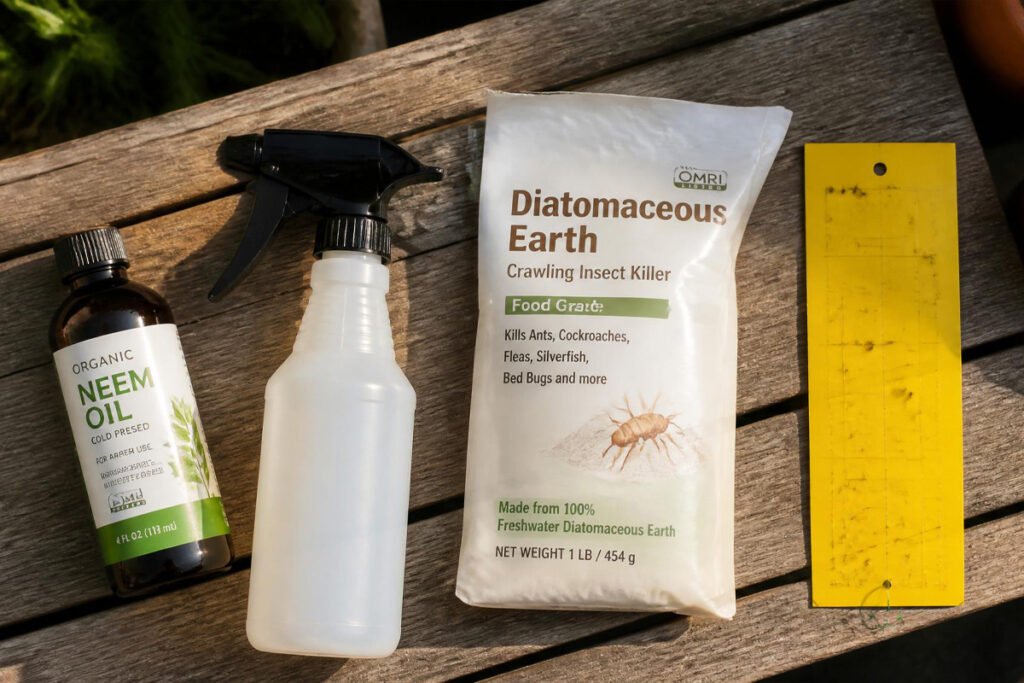
Table of Contents
- Why Matching the Product to the Pest Matters
- How to Choose the Right Organic Pest Control Product
- Best Organic Pest Control Products
- Comparison Table
- Pest Control Products for Different Garden Setups
- How to Apply Organic Pest Control Correctly
- Common Organic Pest Control Mistakes
- Expert Tips
- Final Thoughts
- Frequently Asked Questions
Why Matching the Product to the Pest Matters {#why-matching-matters}
Organic pest control products aren’t interchangeable the way their shared “organic” label might suggest. Diatomaceous earth works through a purely physical mechanism, damaging the outer layer of crawling insects until they dehydrate, which means it does essentially nothing against flying pests it never makes contact with. Bt spray, by contrast, works because caterpillars ingest it directly while feeding on treated leaves, so it’s specifically ineffective against pests that don’t chew on foliage the same way.
This is why correctly identifying the pest first — not just seeing “bug damage” and grabbing whatever’s on the shelf — is the actual foundation of effective organic pest control. A garden dealing with aphids needs a completely different product than one dealing with slugs, even though both are technically “pests” and both problems could technically be labeled the same way in a panic. Good pest identification, paired with consistent weed control to remove alternate pest habitats, does more to solve a pest problem than any single product used incorrectly.
How to Choose the Right Organic Pest Control Product {#how-to-choose}
Before buying, answer three questions:
What pest are you actually seeing? Soft-bodied insects like aphids and whiteflies respond well to neem oil or insecticidal soap, while crawling pests like slugs and beetles are better matched to diatomaceous earth.
Is the pest chewing foliage, or sucking plant juices? Caterpillars that chew leaves respond specifically to Bt spray, while sap-sucking insects like aphids need a contact product like insecticidal soap or neem oil instead.
Do you need active treatment, or ongoing monitoring? Sticky traps work well as an early-warning system to catch pest pressure before it becomes severe, complementing active products rather than replacing them.
Best Organic Pest Control Products {#best-products}
Neem Oil
Overview: A plant-derived oil pressed from neem tree seeds, used as a broad-spectrum organic pesticide that disrupts feeding and reproduction in a wide range of soft-bodied insects.
Why It Works: Neem oil contains compounds that interfere with an insect’s hormone system, disrupting feeding behavior and preventing normal reproduction and development rather than killing on immediate contact the way some products do. This makes it especially effective as a preventive and ongoing control measure against aphids, whiteflies, and mites, since it breaks the pest’s life cycle over repeated applications rather than relying on a single knockdown effect.
Key Features:
- Disrupts insect feeding and reproduction rather than just killing on contact
- Effective against a broad range of soft-bodied pests
- Also has some fungal disease-suppressing properties as a secondary benefit
Best For: Aphids, whiteflies, spider mites, and other soft-bodied sap-sucking pests.
Pros: ✅ Broad-spectrum effectiveness against many common pests ✅ Disrupts pest life cycles, not just immediate contact ✅ Secondary benefit against some fungal issues
Cons: ❌ Slower-acting than direct-contact products ❌ Can affect beneficial insects if sprayed directly on them during application
Our Verdict: Worth having as a go-to first response for the most common soft-bodied pests — apply in the evening to minimize contact with pollinators, since neem affects insects broadly regardless of whether they’re a pest or a beneficial species, and it pairs well with companion planting that already attracts beneficial insects to the garden.
Insecticidal Soap
Overview: A specially formulated soap solution that breaks down the protective outer coating of soft-bodied insects on direct contact, causing them to dehydrate and die.
Why It Works: Unlike neem oil’s slower hormonal disruption, insecticidal soap acts quickly and directly by dissolving the waxy or soft outer layer that many small insects rely on to retain moisture, leading to rapid dehydration once contact is made. Because it needs direct contact to work and breaks down quickly afterward, it has a much shorter environmental persistence than many other pest control options, making it a good fit for gardens where minimizing residue matters.
Key Features:
- Fast-acting on direct contact with target pests
- Breaks down quickly after application, leaving minimal residue
- Effective against aphids, mites, and other soft-bodied insects
Best For: Fast knockdown of visible aphid or mite infestations on contact.
Pros: ✅ Fast-acting compared to slower hormonal disruptors ✅ Minimal lasting residue ✅ Simple to apply as a direct spray
Cons: ❌ Requires direct contact with the pest to work, missing insects it doesn’t touch ❌ Can occasionally cause leaf damage on sensitive plants if overused
Our Verdict: Worth keeping on hand for the moments when you spot an active infestation and want a fast response — its need for direct contact means thorough spray coverage matters more than with slower-acting products like neem oil, so pair it with a reliable watering can or sprayer setup for even application.
Diatomaceous Earth
Overview: A powder made from the fossilized remains of tiny aquatic organisms called diatoms, used to control crawling insects through a purely physical, non-chemical mechanism.
Why It Works: At a microscopic level, diatomaceous earth particles have sharp edges that damage the waxy outer coating of crawling insects like slugs and beetles as they move across a treated surface, causing them to lose moisture and dehydrate. Because this mechanism is entirely physical rather than chemical, insects can’t develop resistance to it the way they sometimes can to chemical products, making it a reliably consistent option against the crawling pests it targets.
Key Features:
- Physical mechanism means pests can’t build resistance over time
- Effective against slugs, beetles, and other crawling insects
- Food-grade versions are safe to use around edible crops
Best For: Slugs, beetles, and other crawling pests that move across treated soil or plant surfaces.
Pros: ✅ No resistance buildup possible due to physical mechanism ✅ Long-lasting once applied, as long as it stays dry ✅ Safe for use around edible crops in food-grade form
Cons: ❌ Loses effectiveness once wet and needs reapplication after rain ❌ Does nothing against flying or non-crawling pests
Our Verdict: Worth buying specifically for slug and beetle problems — reapply after every rain or heavy watering, since its effectiveness depends entirely on staying dry to maintain its physical action against crawling pests.
Bt Spray (Bacillus thuringiensis)
Overview: A naturally occurring soil bacteria formulated into a spray that specifically targets caterpillars, causing fatal digestive disruption once ingested while feeding on treated foliage.
Why It Works: Bt produces a protein that’s toxic specifically to caterpillar digestive systems once ingested, but is essentially harmless to humans, pets, and most other insects that don’t share the same digestive chemistry, making it one of the most narrowly targeted organic pest products available. Because caterpillars must actually eat the treated leaf to be affected, Bt works specifically for chewing pests and has no effect on sap-sucking insects like aphids.
Key Features:
- Extremely targeted action, affecting caterpillars specifically
- Harmless to most beneficial insects, pets, and humans
- Must be reapplied after rain since it breaks down in sunlight and moisture
Best For: Caterpillar pests like cabbage worms, tomato hornworms, and other leaf-chewing larvae.
Pros: ✅ Extremely targeted, minimizing harm to beneficial insects ✅ Safe around food crops close to harvest ✅ Effective against a wide range of caterpillar species
Cons: ❌ Only effective against caterpillars, not other pest types ❌ Breaks down relatively quickly in sunlight, requiring more frequent reapplication
Our Verdict: Worth buying specifically once you spot caterpillar damage or the caterpillars themselves — its narrow targeting means it won’t help with other pests, but for the specific problem of leaf-chewing larvae, it’s one of the most effective and beneficial-insect-safe options available, especially useful for protecting young transplants started via seed starting supplies.
Sticky Traps
Overview: Brightly colored cards coated in a non-toxic adhesive, used to passively capture flying pests that are attracted to the trap’s color, doubling as an early monitoring tool for pest pressure.
Why It Works: Many common flying garden pests, including whiteflies and fungus gnats, are strongly attracted to certain colors, particularly yellow, which the traps use to lure pests directly onto the adhesive surface without needing any spray or active treatment. Because they work passively and continuously, sticky traps also function as an early warning system, letting gardeners spot a growing pest population before it becomes a full infestation requiring more active treatment.
Key Features:
- Passive capture requires no spraying or active application
- Doubles as an early monitoring tool for pest population trends
- Non-toxic adhesive is safe around edible crops and beneficial insects
Best For: Monitoring and reducing flying pests like whiteflies, fungus gnats, and some flying beetles.
Pros: ✅ No spraying or chemical application needed ✅ Useful as an early pest-monitoring tool ✅ Safe around edible crops
Cons: ❌ Only captures flying pests attracted to the trap’s color ❌ Can occasionally catch beneficial flying insects along with pests
Our Verdict: Worth placing throughout the garden as much for monitoring as for direct control — checking traps regularly gives an early signal of rising pest pressure well before damage becomes visible on the plants themselves.
Comparison Table {#comparison-table}
| Product | Best For | Mechanism | Speed | Beneficial-Insect-Safe |
|---|---|---|---|---|
| Neem Oil | Aphids, whiteflies, mites | Hormonal disruption | Slower | Moderate (apply in evening) |
| Insecticidal Soap | Fast aphid/mite knockdown | Contact dehydration | Fast | Moderate (direct contact only) |
| Diatomaceous Earth | Slugs, beetles | Physical dehydration | Moderate | High (targets crawling pests) |
| Bt Spray | Caterpillars | Digestive toxin (ingestion) | Moderate | Very High |
| Sticky Traps | Flying pests, monitoring | Passive adhesive capture | Ongoing | Moderate |
Pest Control Products for Different Garden Setups {#different-setups}
Raised Bed Gardens
Raised beds benefit from a combination of sticky traps for early monitoring and diatomaceous earth around bed edges, since slugs and crawling pests are common visitors to the moist, protected soil that a well-mulched raised bed tends to hold.
Single-Plot In-Ground Gardens
Larger in-ground plots often deal with a wider variety of pests across a bigger area, making neem oil’s broad-spectrum action and Bt spray’s targeted caterpillar control a useful combination for covering more ground efficiently.
Container and Small-Space Gardens
Container gardens are especially prone to fungus gnats and whiteflies due to consistently moist potting soil, making sticky traps and occasional insecticidal soap applications particularly effective in this setup.
How to Apply Organic Pest Control Correctly {#how-to-apply}
Step 1: Identify the Pest Before Choosing a Product
Look closely at the damage pattern and any visible insects to confirm what you’re actually dealing with before selecting a treatment, since misidentifying the pest wastes both product and time.
Step 2: Apply Contact Products Directly and Thoroughly
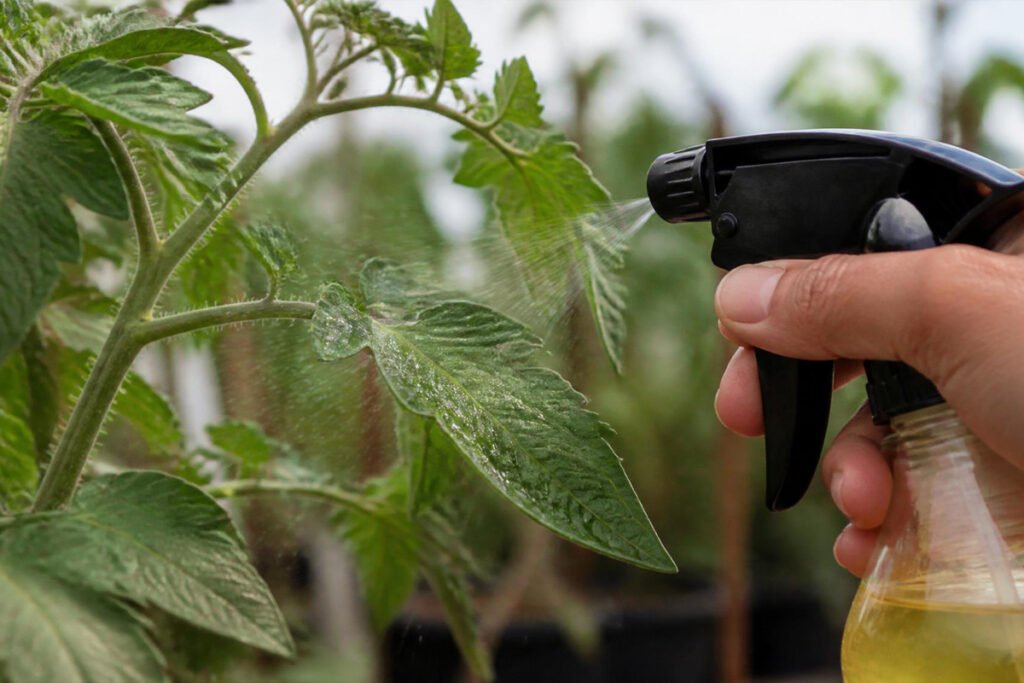
For neem oil and insecticidal soap, ensure thorough coverage of affected leaves, including undersides, since both products need direct contact with the pest to work.
Step 3: Time Applications to Protect Beneficial Insects
Spray neem oil and insecticidal soap in the early morning or evening when pollinators are less active, reducing unintended impact on beneficial insects.
Step 4: Reapply After Rain or Heavy Watering
Diatomaceous earth and Bt spray both lose effectiveness when wet, so plan to reapply after any significant rainfall for continued protection.
Step 5: Monitor with Sticky Traps Between Treatments
Check sticky traps regularly to track whether pest pressure is increasing or decreasing, adjusting your treatment approach based on what the traps actually show.
Common Organic Pest Control Mistakes {#common-mistakes}
Using the wrong product for the actual pest present. Applying diatomaceous earth for an aphid problem, or Bt spray for a slug problem, wastes product entirely since neither is matched to that pest’s biology. Confirm pest identification first.
Spraying contact products during peak pollinator activity. Both neem oil and insecticidal soap can affect beneficial insects present at the time of application. Spray during early morning or evening hours instead.
Forgetting that most organic products need reapplication. Unlike some synthetic options, organic pest control products generally break down faster and need more frequent reapplication, especially after rain, to maintain consistent protection alongside a good pest control routine and reliable gardening tools for regular application.
Expert Tips {#expert-tips}
Combine monitoring with active treatment. Using sticky traps alongside neem oil or insecticidal soap means you catch rising pest pressure early, often before visible plant damage even appears.
Reduce pest pressure structurally, not just chemically. Good weed control removes many alternate host habitats that let pest populations build up between vegetable plantings.
Rotate your pest-control approach along with your crops. Following a solid crop rotation plan naturally reduces the buildup of pests that specialize in a single plant family, meaning less reliance on any single product over time.

Final Thoughts {#final-thoughts}
Best overall: neem oil, for its broad-spectrum effectiveness against the most common soft-bodied pests. Best for fast results: insecticidal soap, when you need a quick response to a visible infestation. Best for monitoring: sticky traps, which catch rising pest pressure before it becomes a serious problem.
Organic pest control works best as a targeted response, not a blanket spray-everything approach. Correctly identifying the pest, choosing the product actually built to address it, and combining that with good weed control, crop rotation, and solid soil health habits does far more for a healthy vegetable garden than relying on any single product alone.
Frequently Asked Questions {#faq}
Can I use neem oil and insecticidal soap at the same time? It’s generally better to use one at a time rather than combining them in the same application, since layering products can increase the risk of leaf damage on sensitive plants.
Is diatomaceous earth safe for pets and beneficial insects? Food-grade diatomaceous earth is safe around pets, but it can affect any crawling insect it contacts, including some beneficial ground insects, so targeted application around known slug or beetle activity is best.
How often should I reapply Bt spray? Bt breaks down relatively quickly in sunlight and after rain, so reapplication every week or after significant rainfall is generally necessary during an active caterpillar problem.
Do sticky traps actually reduce pest populations, or just monitor them? They do both — while primarily useful for monitoring pest pressure, the trapped insects are also removed from the population, providing some direct control alongside the monitoring benefit.
Will neem oil harm ladybugs and other beneficial insects? It can affect beneficial insects if sprayed directly on them, which is why applying in the evening when many beneficial insects are less active helps reduce unintended impact.
What’s the fastest-acting organic pest control product? Insecticidal soap generally acts fastest among these options, since its contact-based dehydration mechanism works quickly once it touches a soft-bodied pest.
Can I use these products on the same day I plan to harvest? Most of these organic products have relatively short pre-harvest intervals compared to synthetic pesticides, but always check specific product labeling for exact guidance before harvesting treated crops.
Does diatomaceous earth work if the soil is wet? No, its physical mechanism depends on staying dry, so effectiveness drops significantly after rain or heavy watering until it’s reapplied and allowed to dry again.
Is Bt spray safe to use around children and pets? Yes, Bt is considered one of the safer organic pest options for areas with children and pets, since its toxic mechanism is specific to caterpillar digestive systems rather than broader biological systems.
How do I know if I have aphids or a different soft-bodied pest? Aphids typically appear as small clusters of soft-bodied insects on new growth and stem joints, often accompanied by a sticky residue called honeydew, distinguishing them from other pests like mites, which are usually too small to see without close inspection.
Can sticky traps catch beneficial insects by accident? Yes, some beneficial flying insects can be attracted to the same colors as pests, so placing traps strategically near known problem areas rather than blanketing the entire garden helps minimize this tradeoff.
Do I need all five of these products, or just one or two? Most gardens do well with two or three products matched to their most common pests — for example, neem oil or insecticidal soap for aphids, plus diatomaceous earth if slugs are a recurring issue, kept alongside good row cover practices for physical pest exclusion.
Author: Pamela Reese
Pingback: 6 Best Row Covers for Frost & Pest Protection: Proven Top Picks & Buying Guide | Pro Gardening Tips – Expert Advice for a Thriving Garden
Pingback: 7 Best Garden Sprayers for Fertilizing, Pest Control & Weeding: Proven Top Picks & Buying Guide | Pro Gardening Tips – Expert Advice for a Thriving Garden