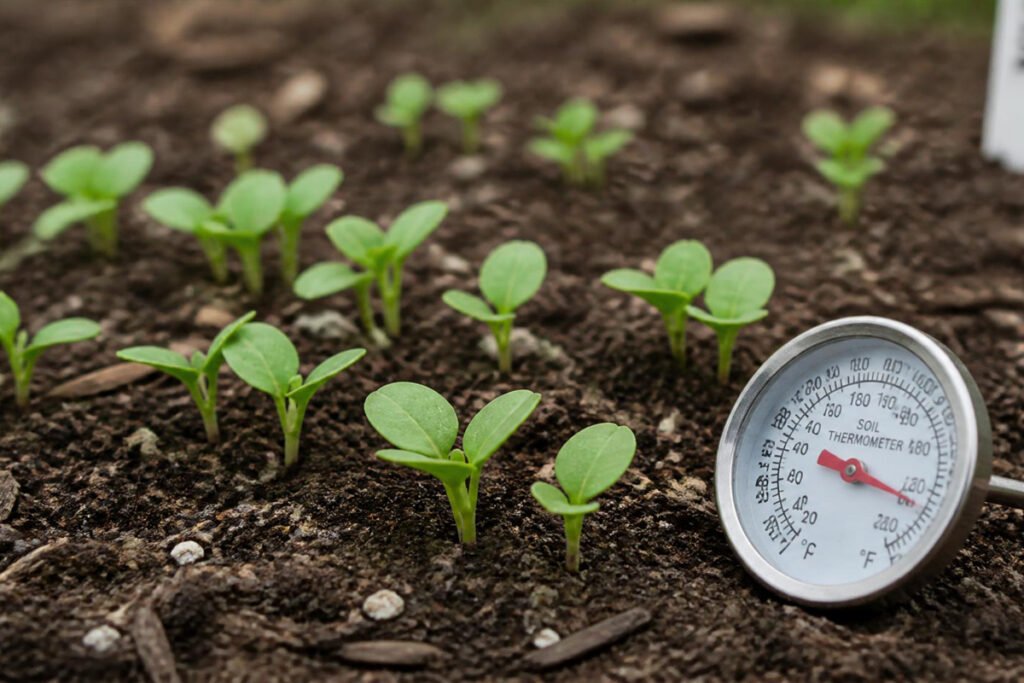
The calendar says it’s planting season, but the soil doesn’t read calendars. Cold, damp ground rots seeds before they germinate, no matter how perfect the date looks on paper — and warm-season crops like tomatoes and peppers planted into 60°F soil will sit stalled for weeks while a bed just a few degrees warmer produces strong, even germination. Soil temperature, not air temperature or the date on a seed packet, is what actually triggers germination.
This guide compares the best soil thermometers for 2026, from simple analog dials to instant-read digital models built for seed trays, garden beds, and compost piles. If you’re timing your first seeds of the season, pair this with our seed starting supplies guide, and if germination has been inconsistent, our soil testing and pH guide covers the other half of what’s happening underground.
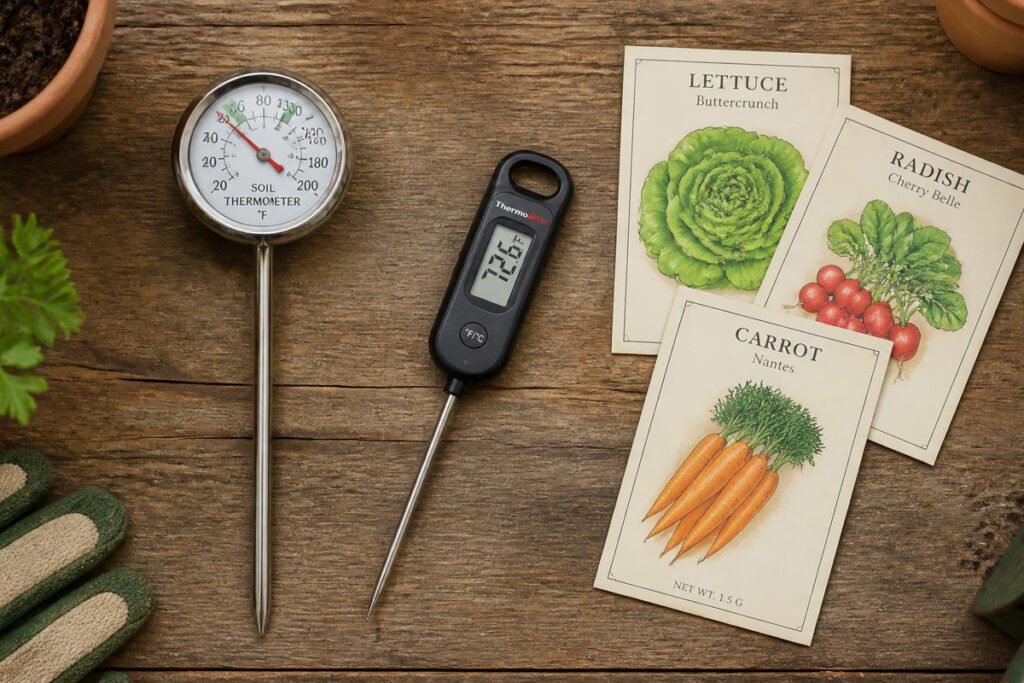
Quick Picks
| If you need… | Best pick |
|---|---|
| Best overall accuracy | REOTEMP K82-3 (5-inch probe) |
| Best for beginners | Luster Leaf Rapitest 1630 |
| Best budget dial thermometer | Taylor Soil Testing Thermometer |
| Best for compost and deep soil | REOTEMP 20-Inch Compost Thermometer |
| Fastest instant-read digital | Smartro ST59 |
| Best for seed trays & heat mats | Burpee Dial Soil Thermometer |
Why Soil Temperature Matters More Than the Calendar
Every seed variety has a temperature window it needs to germinate reliably. Cool-season crops like spinach and lettuce want soil around 50–65°F and can fail to sprout at all if it’s too warm; warm-season crops like tomatoes and peppers need 75–85°F soil to germinate quickly and evenly, and will often rot or stall for weeks if planted too early into cold ground. According to University of Minnesota Extension, monitoring soil temperature directly is one of the simplest, most reliable ways to improve planting outcomes across different climates and seasons — far more reliable than going by air temperature or a fixed calendar date.
A soil thermometer removes that guesswork entirely. Instead of hoping the “average last frost date” applies to your specific yard this year, you check the actual ground conditions each morning and plant when the soil itself says it’s ready.
How to Choose the Right Soil Thermometer
Before buying, consider:
- Probe length. A 4–5 inch probe covers standard seed-starting and transplant depth. If you’re also monitoring compost piles or deep raised beds, you’ll want a longer 12–20 inch probe to reach those deeper temperature zones.
- Analog dial vs. digital readout. Dial thermometers need no batteries and give an instant visual read, often with color-coded planting zones. Digital models give an exact number, which matters if you’re tracking precise temperature trends over time.
- Calibration and durability. Look for factory-calibrated stainless steel probes — cheap thermometers can drift several degrees off accurate over time, which matters when you’re working within a narrow 5–10 degree germination window.
Best Soil Thermometers Available
1. REOTEMP K82-3 Soil Thermometer
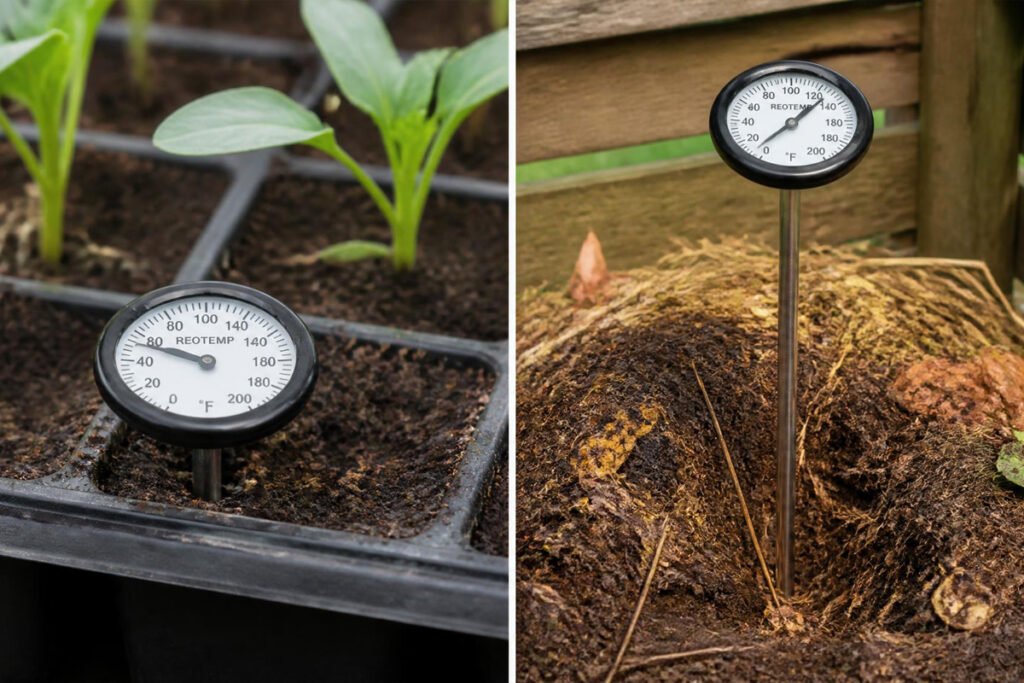
Overview: The REOTEMP K82-3 is the thermometer experienced growers reach for specifically because it does the basics exceptionally well — a 5-inch, 304 stainless steel probe that comes factory calibrated out of the box and delivers a reading in about a second, without the drift cheaper dials develop over time.
Key Features:
- 5-inch 304 stainless steel probe
- Factory calibrated for accuracy
- Fast, roughly one-second readings
- Durable construction built for repeated seasonal use
Best For: Gardeners who want dependable, fast, accurate readings without extra features to fuss over.
Pros: ✅ Excellent accuracy out of the box ✅ Fast readings ✅ Durable stainless steel build Cons: ❌ No color-coded planting guide like beginner-focused models ❌ Standard probe length isn’t suited for deep compost monitoring
Our Verdict: If you want one reliable thermometer and nothing more, this is it — the accuracy and speed matter more over a full growing season than any extra feature.
2. Luster Leaf Rapitest 1630
Overview: Built specifically with beginners in mind, the Rapitest 1630’s dial is printed with recommended planting temperatures for a range of common vegetables, turning a raw temperature reading into an immediate, actionable answer about whether it’s time to plant.
Key Features:
- Dial printed with ideal planting temperatures for common crops
- Stainless steel probe
- Simple, no-guesswork readout
- Compact and easy to store between seasons
Best For: New vegetable gardeners who want the thermometer to translate the reading into a planting decision.
Pros: ✅ Removes guesswork for beginners ✅ Covers a wide range of common crops ✅ Simple, durable design Cons: ❌ Printed crop list won’t cover every variety you might grow ❌ Standard depth, not suited for deep soil or compost
Our Verdict: A smart first thermometer if you’re new to timing your own plantings — it pairs the reading directly with a decision, which our seed starting supplies guide complements well for a complete beginner setup.
3. Taylor Soil Testing Thermometer
Overview: Taylor’s dial thermometer covers the fundamentals at a lower price point, with a broad 20°F to 180°F range and a stem clip that lets you leave it attached to a planter or container for repeated, consistent checks rather than reinserting it each time.
Key Features:
- Broad temperature range (20°F to 180°F)
- 4-inch stem, measures roughly 2 inches below the surface
- Includes a stem clip for attaching to planters
- Heavy-duty stainless steel construction
Best For: Budget-conscious gardeners who want reliable basic readings without premium pricing.
Pros: ✅ Affordable ✅ Wide usable temperature range ✅ Stem clip adds convenience for repeated checks Cons: ❌ Shorter probe than premium options ❌ Basic dial without a printed planting guide
Our Verdict: A solid, no-frills entry point if you just want reliable numbers without paying for extra features — pairs well alongside a soil moisture meter for a fuller picture of planting conditions.
4. REOTEMP 20-Inch Compost & Deep Soil Thermometer
Overview: Standard seed-starting thermometers can’t reach the temperatures or depths active compost piles reach. This extended-probe REOTEMP model is built specifically for that job, with a 20-inch stem that reaches deep into a compost pile or raised bed and a scale that goes up to 200°F to track active decomposition heat.
Key Features:
- Extra-long 20-inch stainless steel probe
- Temperature range up to 200°F for active compost monitoring
- Durable construction for repeated deep insertions
- Also usable for standard deep-soil temperature checks
Best For: Gardeners actively managing a compost pile, or checking temperature deep within large raised beds.
Pros: ✅ Reaches depths standard thermometers can’t ✅ Wide temperature range covers active compost heat ✅ Durable for repeated use Cons: ❌ Overkill for standard seed-starting depth checks ❌ Longer probe is less convenient for shallow trays
Our Verdict: If you’re managing an active compost pile from our composting bins guide, this solves a problem standard soil thermometers simply can’t — tracking whether your pile is actually hot enough to break down efficiently.
5. Smartro ST59 Instant-Read Digital Thermometer
Overview: For gardeners checking multiple beds or zones in a single morning, the Smartro ST59’s instant-read digital display saves real time compared to waiting on a dial to settle, giving an exact numeric reading rather than an approximate needle position.
Key Features:
- Instant-read digital display
- Exact numeric temperature readout
- Compact, easy to carry between garden zones
- Simple battery-powered operation
Best For: Gardeners checking several beds or planting zones quickly and wanting precise numbers rather than a dial estimate.
Pros: ✅ Fast, exact digital readings ✅ Convenient for checking multiple spots quickly ✅ Easy to read display Cons: ❌ Requires batteries ❌ No printed planting guide for reference
Our Verdict: Worth the switch from a dial if you’re regularly comparing temperatures across several different garden zones and want precise numbers to track trends over the season.
6. Burpee Dial Soil Thermometer
Overview: Scaled specifically for seed trays and small containers, the Burpee’s compact size and highlighted “ideal” temperature zones make it purpose-built for indoor seed starting, especially for checking that heat mats are warming trays to the right level without overheating delicate seedlings.
Key Features:
- Compact size suited to seed trays and small pots
- Dial highlights ideal germination temperature ranges
- Short probe scaled for shallow starting media
- Calibrated for the narrow windows seed germination requires
Best For: Indoor seed starting, especially when using heat mats to warm trays.
Pros: ✅ Purpose-built for shallow seed-tray depth ✅ Highlighted ideal ranges simplify reading ✅ Compact and easy to use indoors Cons: ❌ Too short a probe for garden beds or deeper containers ❌ Limited to seed-starting use cases
Our Verdict: If you’re starting seeds under grow lights with a heat mat, this thermometer directly answers the one question that matters most: is the tray actually warm enough to germinate.
Comparison Table
| Thermometer | Best For | Probe Length | Type | Range |
|---|---|---|---|---|
| REOTEMP K82-3 | Overall accuracy | 5 in | Dial (analog) | Standard |
| Luster Leaf Rapitest 1630 | Beginners | Standard | Dial with crop guide | Standard |
| Taylor Soil Testing | Budget | 4 in | Dial (analog) | 20–180°F |
| REOTEMP 20-Inch | Compost & deep soil | 20 in | Dial (analog) | Up to 200°F |
| Smartro ST59 | Fast multi-zone checks | Standard | Digital instant-read | Standard |
| Burpee Dial | Seed trays & heat mats | Short | Dial with ideal zones | Standard |
Best Thermometers for Different Growing Situations
Starting Seeds Indoors
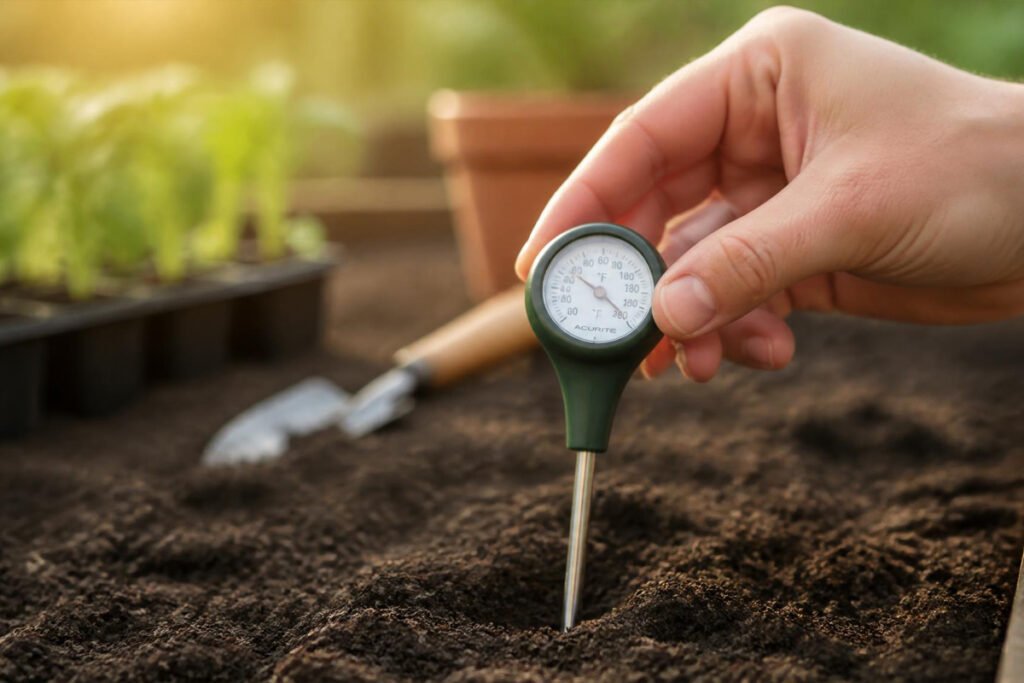
A compact, tray-scaled thermometer like the Burpee pairs naturally with a heat mat and your grow lights for seed starting setup, confirming the starting mix is actually within the germination window rather than assuming the mat is working correctly.
Direct Sowing in Garden Beds
A standard 4–5 inch probe like the REOTEMP K82-3 or Taylor model checks conditions at typical planting depth before you commit seeds to the ground, especially useful alongside our raised bed materials guide for beds that warm at a different rate than in-ground soil.
Active Composting
An extended-probe thermometer like the REOTEMP 20-inch model tracks whether your pile is reaching the heat needed for efficient decomposition — a detail our composting bins guide doesn’t cover in depth on its own.
Common Mistakes
- Planting warm-season crops by the calendar instead of the soil. Tomatoes and peppers planted into soil that’s still in the 60s°F often just sit dormant, or rot outright, even if the date on the seed packet says it’s time.
- Checking temperature at the wrong depth. A reading taken at the surface can be several degrees off from where seeds are actually sitting. Insert the probe to the depth you’re actually planting at, not just an inch or two down.
- Relying on an uncalibrated or old thermometer. Cheap dials can drift several degrees over time, which matters a great deal within a narrow germination window. If your seeds have failed to germinate despite “good” readings, recalibration or a replacement thermometer is worth considering.
Expert Tips
- Check soil temperature at the same time each morning for a few consecutive days, rather than relying on a single reading — soil temperature fluctuates through the day, and a consistent morning check gives a more reliable trend than one spot check.
- Know your specific crop’s window, not just a general range. Warm-season and cool-season crops have genuinely different needs, and the seed starting supplies guide is a useful reference for matching timing to what you’re actually growing.
- Recheck after a cold snap, even mid-season. A late frost or unusually cold stretch can drop soil temperature enough to stall germination for crops planted just before it hit.
Final Thoughts
Best overall: The REOTEMP K82-3 delivers fast, accurate, factory-calibrated readings that hold up over years of seasonal use. Best for beginners: The Luster Leaf Rapitest 1630 turns a raw number into an actual planting decision, removing the guesswork entirely. Best for compost: The REOTEMP 20-Inch reaches depths and temperatures no standard thermometer can track.
Whichever you choose, use it alongside your seed starting supplies and soil testing routine — soil temperature is one more piece of the same underground picture that determines whether your seeds thrive or stall.
Frequently Asked Questions
Do I really need a soil thermometer, or is the calendar close enough? The calendar gives you a rough average, but actual conditions vary by yard, microclimate, and year. A soil thermometer removes the guesswork and tells you the real, current temperature where your seeds will actually sit.
What soil temperature is ideal for tomatoes and peppers? Most warm-season crops like tomatoes and peppers germinate best in soil between 75–85°F. Planted into cooler soil, they’ll often germinate slowly, unevenly, or rot before sprouting at all.
How deep should I insert the probe? Insert it to roughly the same depth you’re planting at — usually 1–2 inches for most seeds, deeper for larger seeds or transplants. A surface-only reading can be noticeably off from the actual temperature at seed depth.
Can I use a meat or cooking thermometer instead? It’s not recommended. Soil thermometers are calibrated and built for the specific range and durability needs of repeated ground insertion, while kitchen thermometers aren’t designed for that use and may give inaccurate readings.
How often should I check soil temperature before planting? Checking once isn’t enough — soil temperature fluctuates day to day, especially in early spring. Checking at the same time each morning for several consecutive days gives a more reliable trend than a single reading.
Do soil thermometers expire or need recalibration? Analog dial thermometers can drift out of calibration over years of use, especially with rough handling. If readings seem consistently off from expected results, recalibrating or replacing the thermometer is worth considering.
What’s the difference between a soil thermometer and a compost thermometer? They work the same way, but compost thermometers typically have longer probes (12–20 inches) and a higher temperature range, since active compost piles reach much higher and deeper heat than standard garden soil.
Can I use one soil thermometer for both seed trays and garden beds? A standard 4–5 inch probe works for both in most cases, though a dedicated shorter thermometer is more convenient for shallow seed trays specifically, since a long probe can be awkward to use in a small container.
Why did my seeds fail to germinate even though the air felt warm enough? Air temperature and soil temperature aren’t the same, and soil warms more slowly than air, especially early in the season. Checking soil temperature directly, rather than going by how warm the day feels, is the more reliable way to time planting.
Is a digital or analog soil thermometer more accurate? Both can be highly accurate if well made and properly calibrated. Digital models give an exact number and often read faster, while analog dials need no batteries and give an immediate visual read — accuracy comes down more to build quality than the display type.
Author: Pamela Reese Last Updated: August 2026