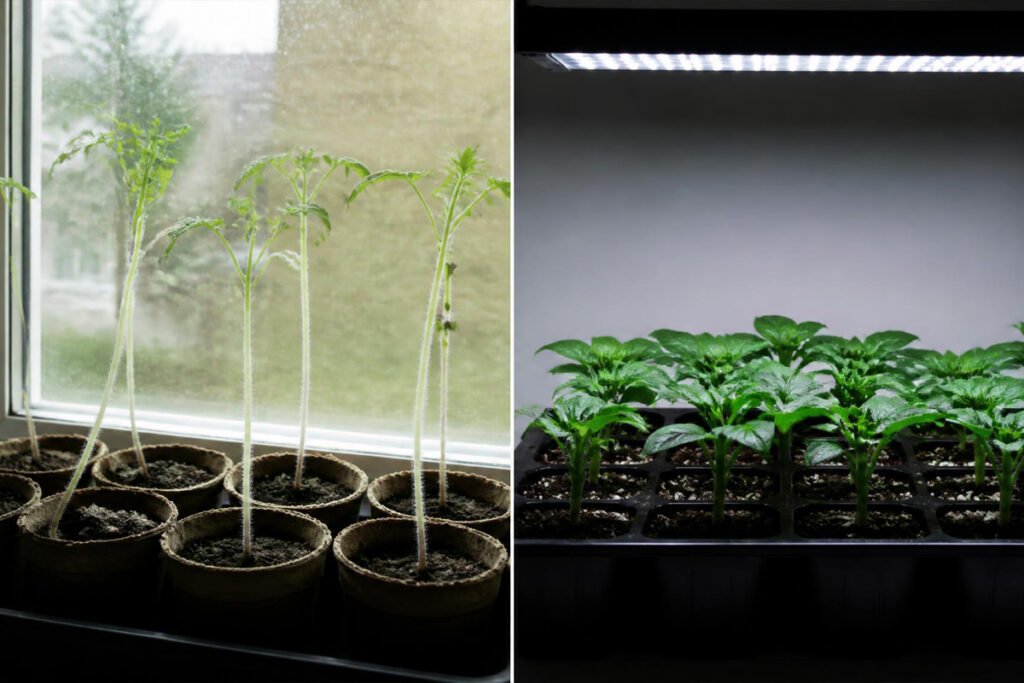
Every seed-starting season, the same disappointment shows up on windowsills everywhere: tomato and pepper seedlings that stretch tall, pale, and floppy instead of growing short and sturdy. It’s rarely a soil or watering problem — it’s light. Even a bright south-facing window delivers a fraction of the light intensity seedlings actually crave, and plants respond by stretching desperately toward whatever light they can find, producing exactly the leggy, weak growth that struggles once transplanted outside.
A dedicated grow light fixes this almost immediately. Positioned close and run on a consistent schedule, the right light produces short, thick-stemmed, deep-green seedlings that transplant far more successfully than anything grown on a windowsill alone. This guide breaks down the best grow lights for seed starting in 2026, how to choose between them, and the setup mistakes that cause leggy growth even with a good light. If you haven’t started your seeds yet, pair this with our 5 Best Seed Starting Supplies for Vegetable Gardens guide.
Quick Answer
For serious, multi-tray seed starting, a full-spectrum LED panel like the VIPARSPECTRA P700 delivers the most even, professional-grade coverage. For a budget-friendly multi-shelf setup, T5 LED strip lights like Barrina offer excellent efficiency and can be linked together across several shelves. For just a windowsill or a single small tray, a clip-on grow light is the simplest, lowest-commitment option. Whatever you choose, the two details that matter more than price are distance from the seedlings (2–4 inches for low-wattage lights) and running them on a consistent 14–16 hour daily schedule with a timer.
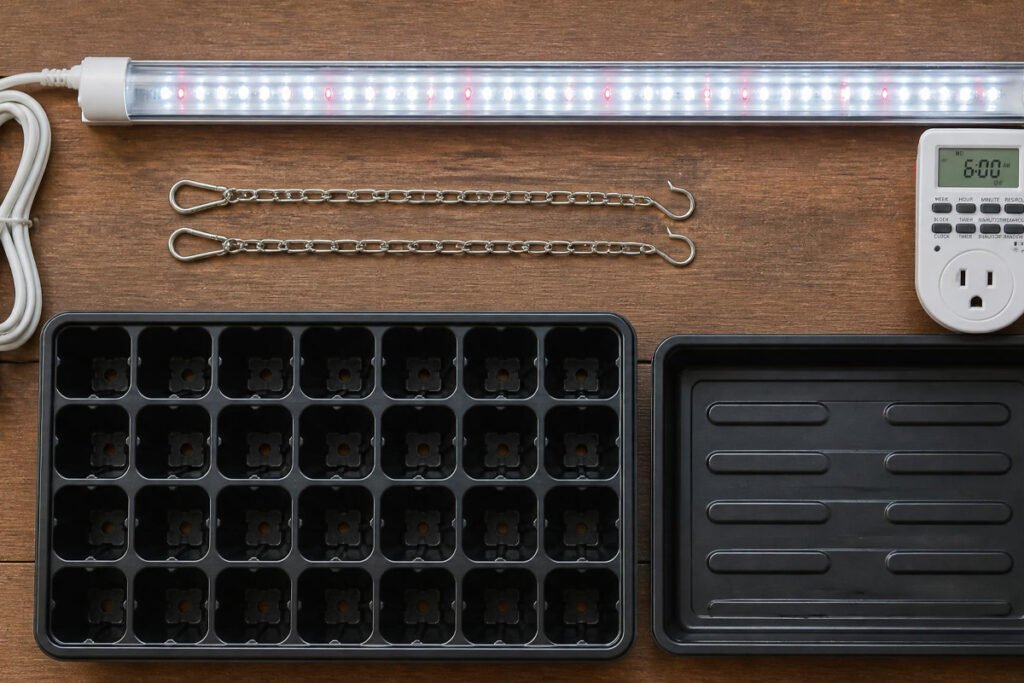
Table of Contents
- Why Grow Lights Matter for Seed Starting
- How to Choose the Right Grow Light
- Best Grow Lights Available
- Comparison Table
- Best Lights for Different Setups
- How to Set Up Grow Lights Correctly
- Common Mistakes
- Expert Tips
- Final Thoughts
- Frequently Asked Questions
Why Grow Lights Matter for Seed Starting
Seedlings are far more light-hungry than most people expect. Even a bright windowsill typically delivers well under half the light intensity a full-spectrum LED can provide up close, and seedlings respond to insufficient light by stretching — a survival response that produces tall, thin, weak stems instead of the short, sturdy growth needed for a plant to handle transplanting and eventually support fruit.
LED grow lights have become the standard recommendation over older fluorescent setups because they run cooler, last longer, and use less electricity for comparable light output. A 5000K–6500K color temperature — a blue-rich spectrum — is generally considered the sweet spot for compact, non-leggy seedling growth.
How to Choose the Right Grow Light
Ask yourself these three questions before buying:
1. How many trays or shelves are you lighting? A single small tray on a windowsill is well served by an inexpensive clip light. Multiple shelves of trays need either a wide panel or several linked T5 strips to cover the full area evenly.
2. Do you want a standalone light or a full setup? All-in-one seed starting systems bundle lights, trays, and timers together for simplicity, at a higher price than assembling components separately.
3. What’s your available space and mounting situation? Panels need overhead clearance and often a stand or shelving unit. T5 strips mount easily under existing shelves. Clip lights need only a shelf edge or nearby surface to clamp onto.
Distance and spectrum matter more than raw wattage — a properly positioned 5000K–6500K light a few inches above seedlings will consistently outperform a far more powerful panel mounted too high or too far away.
Best Grow Lights Available
1. VIPARSPECTRA P700 LED Grow Light Panel
Overview: A full-spectrum LED panel widely regarded as the top all-around choice for serious, multi-tray seed starting. It delivers even, professional-grade light coverage across a wide area, with enough output to support seedlings from germination through to transplant size.
Key Features:
- Full-spectrum LED coverage across a wide panel area
- High light output suitable for multiple trays at once
- Durable build designed for repeated seasonal use
- Even coverage reduces the need for repositioning trays
Best For: Gardeners starting many trays at once who want dedicated, professional-grade coverage.
Pros: ✅ Excellent even coverage across a wide area ✅ Strong output supports seedlings through to transplant ✅ Durable, built for repeated seasonal use
Cons: ❌ Higher upfront cost than strip or clip lights ❌ Requires more overhead clearance and a mounting setup
Our Verdict: If you’re starting more than a couple of trays each season, this is the light that removes coverage as a limiting factor entirely.
2. Barrina T5 LED Grow Light Strips
Overview: Slim, linkable LED strip lights designed to mount directly under shelving, making them the go-to choice for anyone building a multi-shelf indoor seed-starting setup in a basement, garage, or spare room.
Key Features:
- Slim profile mounts easily under shelves
- Multiple strips can be linked together for larger setups
- Full-spectrum LED output at a budget-friendly price point
- Low heat output allows close positioning to seedlings
Best For: Multi-shelf basement or garage seed-starting setups on a budget.
Pros: ✅ Very budget-friendly for the coverage provided ✅ Easy to mount under existing shelving ✅ Linkable for scaling up over time
Cons: ❌ Requires shelving or a mounting structure to use effectively ❌ Individual strips cover less area than a full panel
Our Verdict: The most cost-effective way to build out a serious multi-shelf setup gradually, one strip at a time.
3. GooingTop Clip-On Grow Light
Overview: A compact, gooseneck clip light that clamps onto a shelf edge or table, built for small trays, windowsill setups, or supplementing natural light rather than fully replacing it. Its popularity and consistently high review scores reflect how well it serves casual, small-scale seed starters.
Key Features:
- Flexible gooseneck for precise positioning
- 6000K color temperature suited to seedling growth
- Multiple brightness levels adjustable for germination through growth stages
- Compact clip mount requires no dedicated shelving
Best For: Small trays, windowsill seed starting, or supplementing an already bright location.
Pros: ✅ Very easy to install with no mounting hardware needed ✅ Adjustable brightness for different growth stages ✅ Affordable entry point into grow lighting
Cons: ❌ Limited coverage area, not suited to multiple large trays ❌ Some versions don’t include a built-in timer
Our Verdict: The simplest possible upgrade from a windowsill alone — ideal if you’re only starting a tray or two of herbs or a handful of vegetable starts.
4. Full-Spectrum LED Shop Light Fixture
Overview: A standard, widely available full-spectrum LED shop light — the same style used for garage and workshop lighting — repurposed as an affordable, no-frills seed-starting light. Paired with basic hanging chains for height adjustment, it remains one of the most cost-effective ways to light a full shelf of trays.
Key Features:
- Wide, even light spread across a standard 4-foot fixture
- Full-spectrum output suitable for seedling growth
- Affordable and widely available at hardware stores
- Adjustable hanging height using chain or rope
Best For: Budget-conscious gardeners who want to build a DIY shelf-light setup using hardware-store parts.
Pros: ✅ Very affordable per foot of coverage ✅ Widely available, easy to replace ✅ Simple to hang and adjust height
Cons: ❌ Less specialized spectrum tuning than dedicated grow lights ❌ Requires separate mounting hardware and a timer
Our Verdict: The practical DIY option if you’re comfortable rigging your own shelf setup and want to stretch your budget as far as possible.
5. Epic Gardening Seed Starting System
Overview: An all-in-one seed starting kit that integrates adjustable-height full-spectrum LEDs, growing trays, and timer controls into a single cohesive system, eliminating compatibility guesswork for gardeners who want everything to simply work together out of the box.
Key Features:
- Integrated adjustable-height LED lighting
- Includes matched growing trays
- Built-in timer controls
- Designed as a complete, ready-to-use system
Best For: Gardeners who want a premium, all-inclusive setup without assembling separate components.
Pros: ✅ Everything designed to work together seamlessly ✅ Adjustable height simplifies raising lights as seedlings grow ✅ Built-in timer removes a separate purchase
Cons: ❌ Costs several times more than assembling a comparable DIY setup ❌ Less flexible if you outgrow the included tray capacity
Our Verdict: Worth it if you specifically want a turnkey system and don’t want to shop for trays, timers, and lights separately — otherwise, a T5 strip or panel plus a separate timer covers the same ground for less.
Comparison Table
| Product | Best For | Setup Type | Coverage | Approx. Cost |
|---|---|---|---|---|
| VIPARSPECTRA P700 | Serious multi-tray starting | Panel | Wide, even | $$$ |
| Barrina T5 Strips | Multi-shelf budget setups | Linkable strips | Scales per strip | $$ |
| GooingTop Clip Light | Small trays, windowsills | Clip-on | Small, focused | $ |
| Full-Spectrum LED Shop Light | DIY shelf setups | Hanging fixture | Wide | $ |
| Epic Gardening Seed Starting System | Turnkey all-in-one | Integrated system | Matched to included trays | $$$$ |
Best Lights for Different Setups
For a Full Basement or Garage Shelving Setup
Barrina T5 strips linked across multiple shelves, or a VIPARSPECTRA panel per shelf, give the even coverage a serious multi-tray operation needs. Pair with our 5 Best Seed Starting Supplies for Vegetable Gardens guide for trays and starting mix.
For a Windowsill or Single Small Tray
A clip light like the GooingTop supplements natural light without requiring any dedicated shelving or mounting hardware.
For Gardeners Who Want a Turnkey Solution
The Epic Gardening Seed Starting System removes the need to separately source trays, timers, and lights, trading flexibility for convenience.
How to Set Up Grow Lights Correctly
Step 1: Choose Your Mounting Method
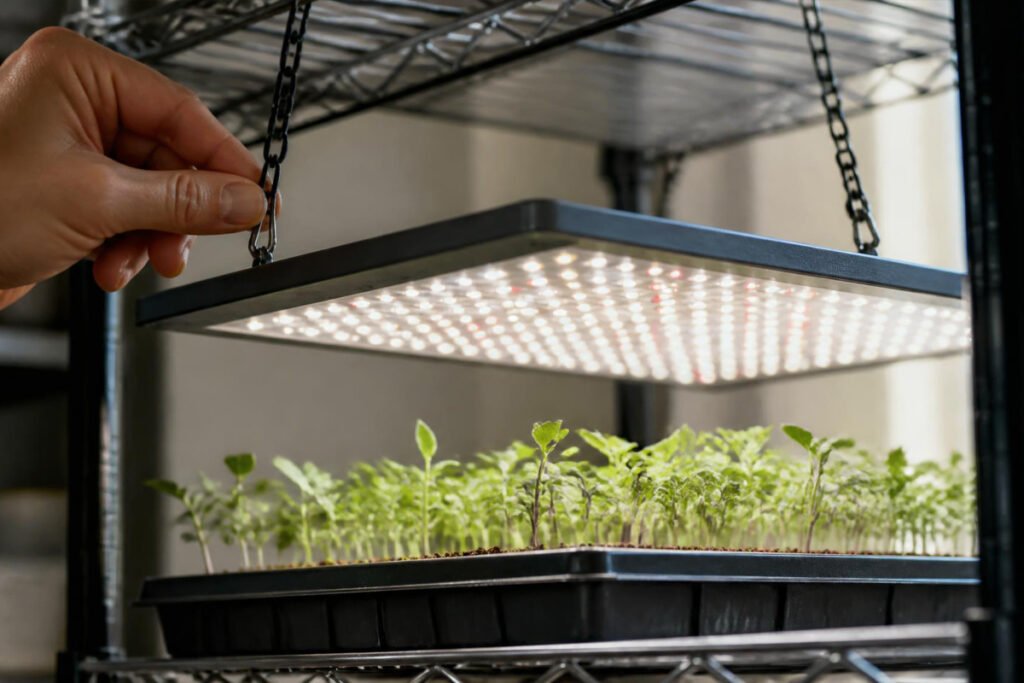
Decide between hanging chains, shelf-clip mounts, or a stand-alone fixture based on your available space and light type.
Step 2: Position Lights Close to Seedlings
For low-wattage LED clip lights and strips, start 2–4 inches above seedlings. For higher-output panels, start further back around 12–24 inches depending on the manufacturer’s guidance.
Step 3: Add a Timer
Set lights to run 14–16 hours per day, consistently, rather than relying on manually turning them on and off.
Step 4: Raise Lights as Seedlings Grow
Adjust height regularly to maintain the recommended distance as plants grow taller, watching for stretching (light too far) or bleached leaves (light too close).
Step 5: Monitor and Adjust
Check seedlings every few days for signs of stress and fine-tune height, duration, or brightness accordingly.
Common Mistakes
1. Relying on a windowsill alone. Even a bright south-facing window rarely provides enough consistent light intensity, leading to the classic pale, leggy seedling problem. A dedicated grow light solves this directly.
2. Positioning lights too far from seedlings. Distance is one of the biggest factors in seedling quality — a light hung too high, regardless of wattage, produces the same stretching problem as insufficient natural light.
3. Running lights inconsistently instead of on a timer. Irregular light schedules stress seedlings more than a consistent 14–16 hour cycle. A basic outlet timer solves this for just a few dollars.
Expert Tips
1. Watch the seedlings, not just the manual. Bleaching or curling leaves mean the light is too close; pale, stretched stems mean it’s too far. Adjust based on what you actually see, not just the recommended starting distance.
2. Combine a heat mat with your grow light setup for warm-season crops. Tomatoes and peppers germinate faster and more reliably with soil temperatures 10–15°F above room temperature, which a light alone doesn’t provide.
3. Don’t skip the timer to save money. A consistent light schedule is one of the cheapest upgrades that meaningfully improves seedling quality — it’s worth prioritizing over a marginally more powerful light.
Final Thoughts
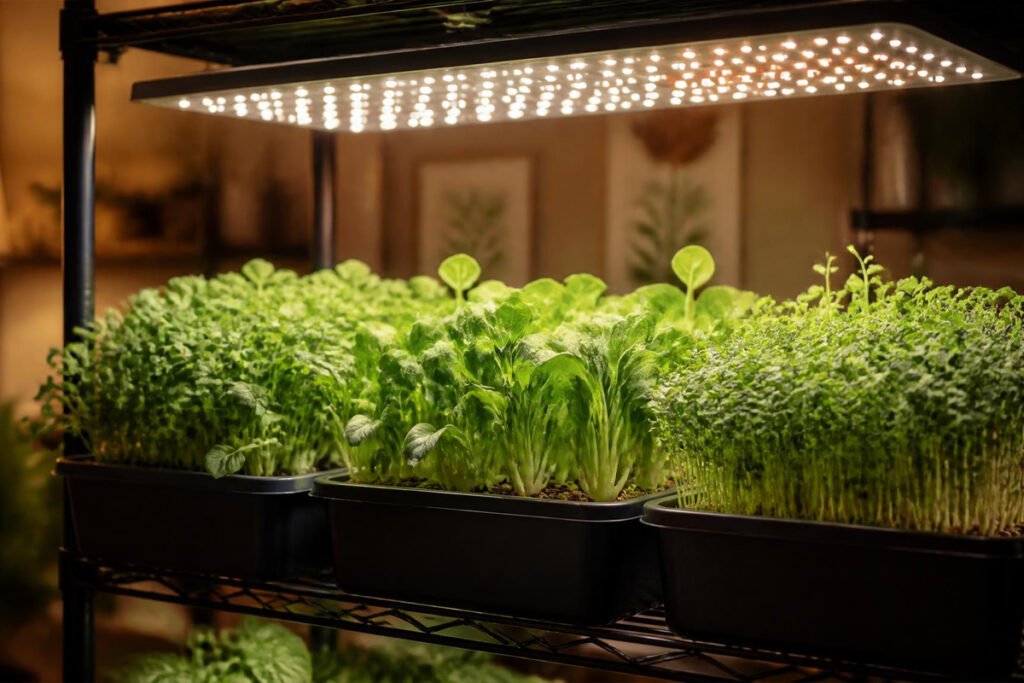
For most home gardeners starting multiple trays, a T5 strip setup or a full-spectrum LED panel delivers the coverage needed for strong, compact seedlings without leggy stretching. Windowsill or single-tray growers do just as well with an affordable clip light, and anyone who wants a fully integrated solution can skip the separate shopping list with an all-in-one system. Whatever you choose, positioning and a consistent timer schedule matter more than price. For next steps, see our 5 Best Seed Starting Supplies for Vegetable Gardens guide.
Frequently Asked Questions
How far should grow lights be from seedlings?
Low-wattage LED clip lights and strips should sit 2–4 inches above seedlings. Mid-range panels typically start at 12–18 inches, and high-output panels at 24 inches or more — always check your specific light’s guidance and adjust based on how seedlings respond.
How many hours a day should grow lights run?
Most seedlings do well with 14–16 hours of light per day, run consistently via a timer rather than an irregular manual schedule.
Do LED or fluorescent grow lights work better for seed starting?
LED lights are generally preferred today — they run cooler, last longer, and use less electricity than fluorescent fixtures for comparable light output, though full-spectrum fluorescent T5 fixtures still work well if that’s what you already have.
Can I use a regular shop light instead of a dedicated grow light?
Yes — a full-spectrum LED shop light is a genuinely effective, budget-friendly option for seed starting, as long as it’s positioned at the right distance and run on a consistent schedule.
Why are my seedlings leggy even with a grow light?
This usually means the light is positioned too far away, is on an inconsistent schedule, or doesn’t provide enough intensity for the number of trays underneath it. Check distance and timer settings first.
Do seedlings need darkness at night?
Yes — running lights 24 hours a day isn’t necessary or beneficial. A 14–16 hour on-cycle with a genuine dark period mimics a healthy natural day-night cycle.
What color temperature is best for seedlings?
A 5000K–6500K full-spectrum, blue-rich light is generally considered the sweet spot for promoting compact, sturdy seedling growth rather than tall, weak stretching.
Author: ProGardeningTips Editorial Team
Last Updated: August 2026