
Overwatering, not neglect, is the single most common way houseplants and container gardens die. It’s an easy mistake to make — the soil surface looks dry, so you water again, without knowing that the root zone underneath is still soaked. A soil moisture meter removes that guesswork entirely: push the probe in, read the result, and know exactly whether a plant needs water today or can wait.
This guide compares the best soil moisture meters available in 2026, from simple no-battery analog dials to multi-function testers that also read pH and light. If you’re building out a full watering routine, pair this with our guide to watering and irrigation solutions, and if you’ve never tested your soil directly, our soil testing and pH guide is a good companion read before you buy anything.
Quick Answer
The best soil moisture meter depends on what you’re growing and how deep the roots sit. For houseplants and shallow containers, a basic analog probe meter like the XLUX Soil Moisture Meter gives instant, reliable readings with no batteries or calibration. For deep pots and raised beds, a long-probe meter reaches the actual root zone instead of just the surface. For hands-off monitoring, a wicking-style indicator like the Sustee Aquameter sits permanently in the pot and changes color when it’s time to water. If you only buy one, a mid-length analog probe meter covers the widest range of everyday gardening needs.
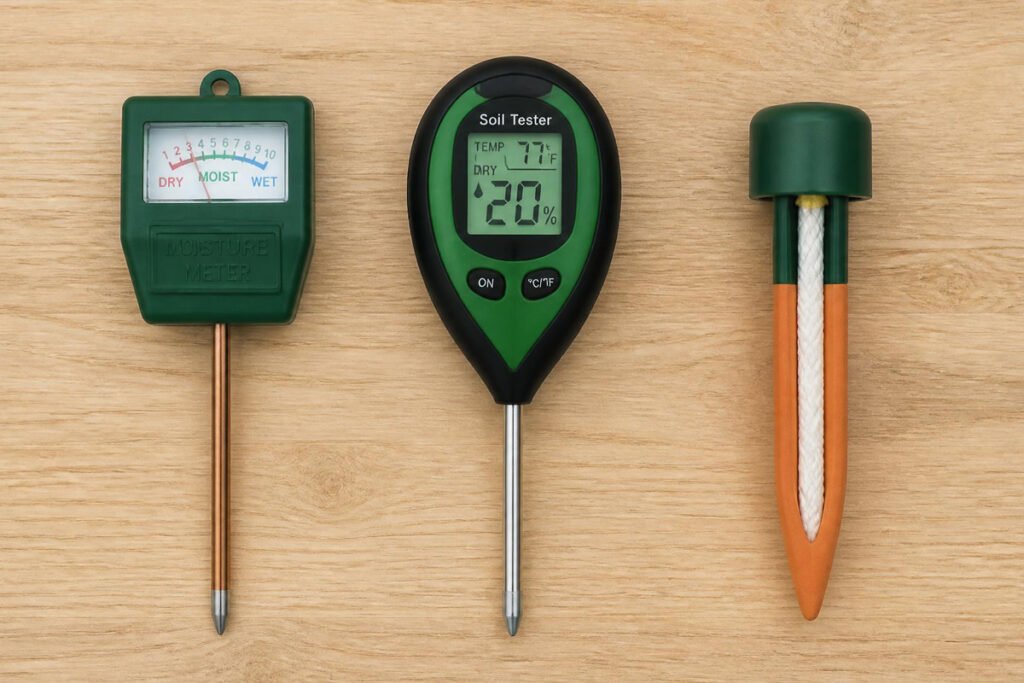
Table of Contents
- What Is a Soil Moisture Meter and How Does It Work?
- How to Choose the Right Soil Moisture Meter
- Best Soil Moisture Meters Available
- Comparison Table
- Best Moisture Meters for Different Growing Situations
- How to Use a Soil Moisture Meter Correctly
- Common Mistakes
- Expert Tips
- Final Thoughts
- Frequently Asked Questions
What Is a Soil Moisture Meter and How Does It Work? {#what-is-it}
Most consumer soil moisture meters work one of three ways:
- Resistive (analog) meters pass a small electrical current between two metal probes. Wetter soil conducts more electricity, which moves a needle on a color-coded dial from “dry” to “wet.” These need no batteries and give instant readings.
- Capacitive (digital) meters measure the soil’s dielectric properties instead of passing current directly through it, which makes them less affected by fertilizer salts or mineral buildup that can throw off resistive readings.
- Wicking indicators use a porous core that draws moisture upward through capillary action, changing color when the surrounding soil dries below a set threshold. These stay in the pot permanently rather than being used for a single spot check.
None of these tools replace understanding your soil in the first place — our soil testing and pH guide covers the broader picture of what’s happening beneath the surface, including nutrient availability that a moisture reading alone won’t tell you.
How to Choose the Right Soil Moisture Meter {#how-to-choose}
Before buying, ask yourself three questions:
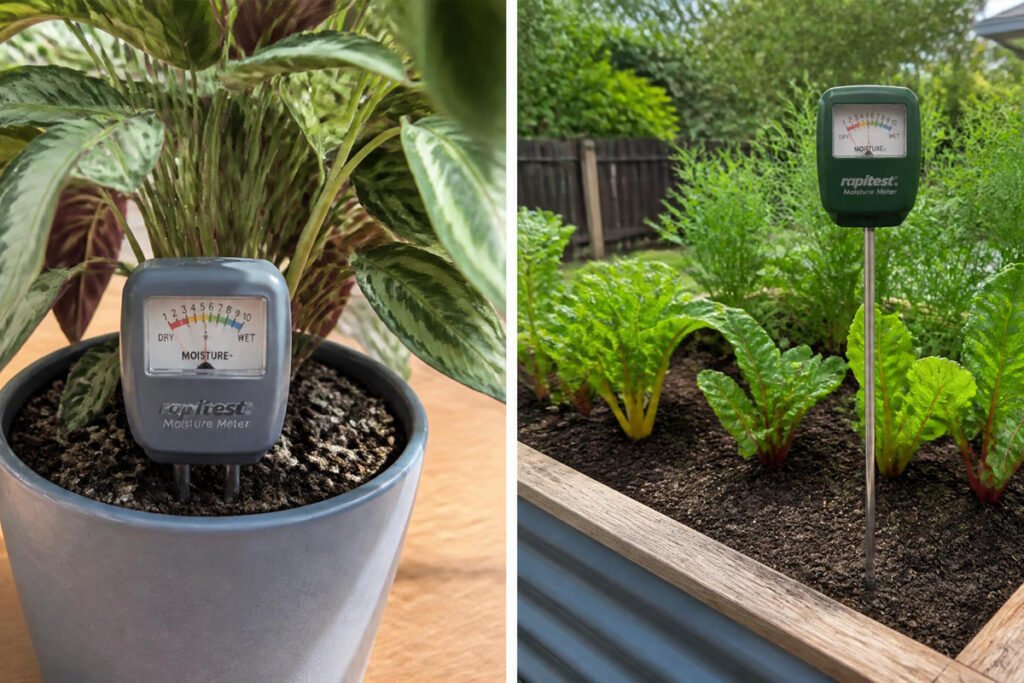
- How deep are the roots I’m measuring? A 4-inch probe only tells you about surface moisture; deep pots and raised beds need a 6- to 12-inch probe to reach the actual root zone.
- Do I want a spot-check tool or a permanent monitor? A probe meter is best for occasional checks across many pots; a wicking indicator or smart sensor is better if you want continuous, hands-off monitoring of one plant.
- What’s my soil type? Clay-heavy soil and heavily fertilized soil can skew resistive-meter readings, since dissolved minerals conduct electricity independently of actual water content — something to keep in mind if your readings ever seem inconsistent with how the soil feels.
For a deeper look at how soil composition affects readings and plant health generally, Colorado State University Extension’s consumer horticulture program publishes research-based guidance on soil water measurement that’s worth a look if you garden in heavier clay soils.
Best Soil Moisture Meters Available {#best-meters}
1. XLUX Soil Moisture Meter (T10)
Overview: The XLUX T10 is the most widely recommended soil moisture meter on the market, and its reputation is earned rather than marketed — it’s a simple analog probe with a color-coded 1–10 dial, no batteries, and no calibration required. Insert it, wait about a minute, and read the result.
Key Features:
- No batteries required — measures via electrical conductance
- Clear color-coded dial (red = dry, green = moist, blue = wet)
- 8-inch stainless steel probe suited to standard pots and garden beds
- Works indoors and outdoors
Best For: Houseplant owners and container gardeners who want a fast, no-fuss answer to “does this need water?”
Pros: ✅ Extremely reliable for the price ✅ Zero running costs ✅ Instant readings, no setup Cons: ❌ Can be thrown off by heavy fertilizer salts or compacted clay ❌ Standard probe length isn’t ideal for very deep containers
Our Verdict: For the vast majority of home gardeners, this is the only soil moisture meter you need. Pair it with the watering guidance in our watering and irrigation solutions guide for a complete routine.
2. XLUX Long-Probe Deep-Use Soil Moisture Meter
Overview: This is the extended-probe version of the classic XLUX design, built specifically for deep containers and raised beds where a standard-length probe only reads surface moisture. The longer reach means you’re checking conditions where the roots actually are, not just the top inch of soil.
Key Features:
- Extra-long probe (roughly 11–12 inches) for deep pots and raised beds
- Same no-battery, color-coded dial as the standard model
- Durable stainless steel construction
Best For: Raised bed vegetable gardens, large planters, and deep containers like fiddle leaf fig pots.
Pros: ✅ Reaches true root-zone moisture in deep soil ✅ No batteries or calibration ✅ Simple, reliable dial Cons: ❌ Manufacturer advises against forcing it into hard, compacted, or dry clay ❌ Overkill for shallow houseplant pots
Our Verdict: If you’re managing raised bed materials or deep containers, this solves the “surface looks dry but roots are fine” problem that shorter meters can’t.
3. Sustee Aquameter
Overview: The Sustee takes a completely different approach — instead of a probe you check periodically, it’s a porous ceramic-core stick that stays permanently in the pot. When the surrounding soil is moist, capillary action draws water into the stick’s indicator, turning it blue; as the soil dries, the color fades back to white, signaling it’s time to water.
Key Features:
- Permanent, always-in-the-pot design — no need to remember to check
- Simple color-change indicator (blue = moist, white = time to water)
- Replaceable inner core, typically swapped every 6–9 months
- Sized specifically for small to medium pots
Best For: Gardeners who want a passive, glance-and-go indicator rather than an active measuring tool.
Pros: ✅ No need to remember to test — just glance at the color ✅ No batteries ✅ Good for gardeners prone to overwatering Cons: ❌ Best suited to water-retentive soils, less accurate in fast-draining mixes ❌ Core needs periodic replacement
Our Verdict: A great complement to a probe meter rather than a replacement — leave one in your most overwatering-prone plant and check it at a glance instead of guessing.
4. Dr.meter S10 Soil Moisture Meter
Overview: The Dr.meter S10 is a budget-friendly analog probe meter that performs nearly identically to the XLUX in standard potting conditions, making it a solid choice if you want to equip several pots without spending much per unit.
Key Features:
- 8-inch probe, no batteries required
- Color-coded dial similar to premium analog meters
- Lightweight, simple construction
Best For: Gardeners with many pots who want an affordable meter for each one rather than sharing a single premium unit.
Pros: ✅ Performs close to premium analog meters ✅ Low cost per unit ✅ Easy to use Cons: ❌ Build quality is a step below premium models ❌ Probe may bend if forced into hard soil
Our Verdict: Buy two or three of these instead of one expensive meter if you’re checking multiple pots regularly — the accuracy difference versus premium analog models is minor.
5. REOTEMP 4-in-1 Soil Tester
Overview: For gardeners who want more than a moisture reading, the REOTEMP 4-in-1 adds pH, temperature, and light intensity to the same probe, giving a fuller picture of growing conditions in a single digital tool with a backlit display.
Key Features:
- Measures moisture, pH, temperature, and light in one device
- Digital backlit display, readable in low light
- Fast readings, typically under 15 seconds
- Portable and lightweight for indoor or outdoor use
Best For: Gardeners who want a single tool that covers multiple diagnostic checks instead of separate testers.
Pros: ✅ Genuinely useful all-in-one functionality ✅ Easy-to-read digital display ✅ Fast results Cons: ❌ Requires batteries ❌ Can’t test water directly or non-soil growing media
Our Verdict: If you’re already using our organic fertilizers and soil amendments guide and want to track how amendments affect pH alongside moisture, this multi-function tester saves you from juggling separate devices.
Comparison Table {#comparison-table}
| Meter | Best For | Type | Probe Length | Battery Required |
|---|---|---|---|---|
| XLUX T10 | Everyday houseplant & garden checks | Analog resistive | ~8 in | No |
| XLUX Long-Probe | Deep pots, raised beds | Analog resistive | ~11–12 in | No |
| Sustee Aquameter | Passive, always-in-pot monitoring | Wicking indicator | N/A | No |
| Dr.meter S10 | Multiple pots on a budget | Analog resistive | ~8 in | No |
| REOTEMP 4-in-1 | Moisture + pH + temp + light in one tool | Digital multi-sensor | Standard probe | Yes |
Best Moisture Meters for Different Growing Situations {#different-situations}
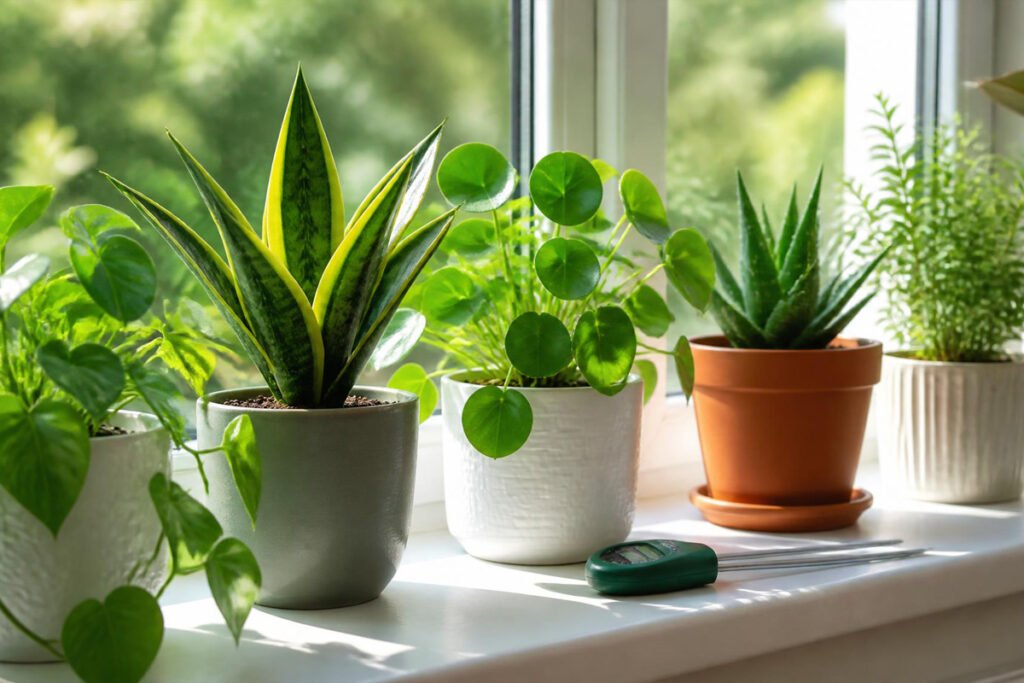
For Houseplants
Shallow to medium pots do best with a standard analog probe like the XLUX T10. If you tend to overwater, adding a Sustee Aquameter to your most sensitive plants gives you a passive early warning between active checks.
For Vegetable Gardens and Raised Beds
Deeper soil needs a longer probe to avoid a false “dry” reading from a surface that’s dried out while the root zone is still wet. Pair a long-probe meter with the guidance in our gardening tools for vegetable gardens roundup and our raised bed materials and kits guide for a complete raised-bed setup.
For Seed Starting
Seedlings are especially sensitive to both over- and under-watering, and a small probe meter can help you avoid the damping-off problems that come from consistently soggy starting mix. This pairs naturally with our seed starting supplies guide and grow lights for seed starting recommendations.
How to Use a Soil Moisture Meter Correctly {#how-to-use}
Step 1: Water the Soil First (for calibration)
Water the plant thoroughly once so you know what a genuine “wet” reading looks like on your specific meter and soil.
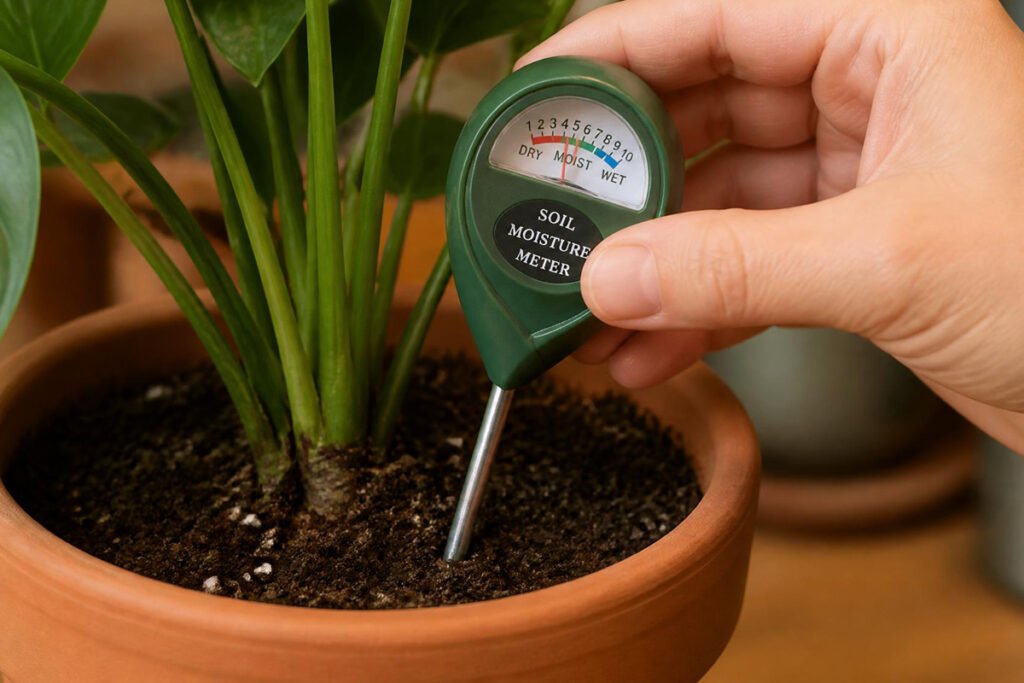
Step 2: Insert the Probe
Push the probe straight down into the soil, avoiding hard forcing into dry, compacted, or clay-heavy ground, which can bend the tip.
Step 3: Wait for a Stable Reading
Give the meter 30–60 seconds to settle before reading the dial or display.
Step 4: Take Multiple Readings for Larger Areas
In garden beds or large containers, check two or three spots and average the results rather than relying on a single point.
Step 5: Compare Against Your Own Baseline
Note the reading right after watering (your “wet” baseline) and again just before the plant starts to wilt (your “dry” baseline) so future readings mean something specific to your soil.
Common Mistakes {#common-mistakes}
- Using a short probe in a deep pot. This only measures surface moisture, which often stays dry even when the actual root zone is still wet — the exact opposite of the reading you need. A long-probe meter solves this for deep containers and raised beds.
- Ignoring soil type when interpreting readings. Clay soil and heavily fertilized soil conduct more electricity independent of actual water content, which can inflate readings on resistive meters. If your meter and the soil test results seem to disagree, soil composition is often why.
- Forcing the probe into hard, dry ground. This is the most common way inexpensive meters break. Water lightly first, or choose a spot in loosened soil, rather than forcing the tip into compacted clay.
Expert Tips {#expert-tips}
- Calibrate to your own soil, not the dial’s factory numbers. A “moist” reading in sandy soil and the same number in clay-heavy soil can represent very different actual water content — track your own wet and dry baselines instead of trusting the number alone.
- Combine a probe meter with a wicking indicator for your trickiest plants. Use the probe for active checks and leave a Sustee-style indicator in the pots you’re most likely to overwater.
- Recheck after fertilizing. Fertilizer salts can temporarily skew resistive-meter readings higher than actual moisture, so give it a day or two after feeding before trusting a borderline reading.
Final Thoughts {#final-thoughts}
Best overall: The XLUX Soil Moisture Meter remains the benchmark — reliable, battery-free, and accurate enough for nearly every home gardening situation. Best for deep containers: The XLUX Long-Probe model solves the surface-vs-root-zone problem that trips up standard meters. Best for hands-off monitoring: The Sustee Aquameter gives you a passive, glance-and-go signal for plants you’re prone to overwatering.
Whatever you choose, treat the reading as one part of a bigger picture — combine it with what you already know from our soil testing and pH guide and watering and irrigation solutions for a watering routine that actually matches what your plants need.
Frequently Asked Questions {#faq}
Do I need a soil moisture meter, or can I just use my finger? The finger test works for surface moisture in shallow pots, but it can’t tell you what’s happening a few inches down, which is exactly where overwatering problems usually start. A meter, especially a long-probe one, gives you that root-zone information directly.
How long do soil moisture meters last? A quality analog meter with no batteries and light use can last for years. The probe tip is usually the first thing to wear out or bend, especially if it’s forced into hard or compacted soil.
Why is my moisture meter giving inconsistent readings? This is usually caused by soil type (clay and heavily fertilized soil conduct more electricity), probe placement (compacted soil reads differently than loose soil), or a bent probe tip. Testing multiple spots and comparing to your own wet/dry baseline usually resolves it.
Can I use a soil moisture meter for outdoor garden beds, not just houseplants? Yes — just make sure the probe is long enough to reach the actual root zone of what you’re growing, which is often deeper than a standard houseplant probe reaches.
Do digital moisture meters work better than analog ones? Not necessarily. Basic analog probes are accurate enough for everyday watering decisions and have no batteries to fail. Digital and multi-function meters add convenience (backlit displays, extra readings like pH) but aren’t inherently more accurate for moisture alone.
How often should I check soil moisture? For houseplants, checking every few days or whenever you’re unsure is plenty. For vegetable gardens and raised beds, especially during hot weather, daily checks help you catch dry-outs before plants show stress.
Can fertilizer affect moisture meter readings? Yes. Fertilizer salts increase the soil’s electrical conductivity, which can make a resistive meter read wetter than the soil actually is for a day or two after feeding.
Is a wicking indicator like the Sustee accurate enough on its own? It’s better used as a passive early-warning signal than a precise measurement tool. For plants where precision matters more, pair it with an occasional probe-meter check.
What probe length do I actually need? As a rule of thumb, match the probe length to roughly two-thirds of your pot or bed’s depth so you’re reading near the root zone rather than just the surface.
Are soil moisture meters worth it for vegetable gardens? Yes, especially during germination and early growth stages, when both over- and under-watering can set seedlings back significantly — see our seed starting supplies guide for the full early-season setup.
Author: Pamela Reese Last Updated: August 2026