Most gardening mistakes aren’t caused by a lack of effort — they’re caused by a lack of information. You water on a schedule instead of when the soil actually needs it. You prune with dull, mismatched shears that crush stems instead of cutting them cleanly. You spend twenty minutes on your knees in wet mulch because you never got around to buying a kneeler. None of these are big problems on their own, but together they’re the difference between a garden that thrives and one that just survives.
The good news is that a handful of well-chosen tools can close most of that gap. This guide rounds up five genuinely useful garden gadgets and accessories — the kind that solve a specific, common problem rather than gathering dust in the shed. If you’re just getting your growing space set up, our raised bed vegetable gardening guide is a good companion piece, and if watering consistency has been your biggest headache, you’ll also want to check our breakdown of efficient watering techniques.
Quick Answer
The best garden gadget depends on the problem you’re actually trying to solve. If you tend to over- or under-water, a soil moisture meter like the XLUX T10 removes the guesswork for a few dollars. If your hands and joints take the brunt of weeding season, a padded kneeler and a proper pair of pruning shears will save you more discomfort than almost any other purchase. If you’re away from home often, a WiFi-connected hose timer such as the Orbit B-hyve or Rachio Smart Hose Timer keeps your beds watered on schedule even when you’re not there. In short: fix the problem that’s costing you the most plants or the most comfort first, then build out from there.
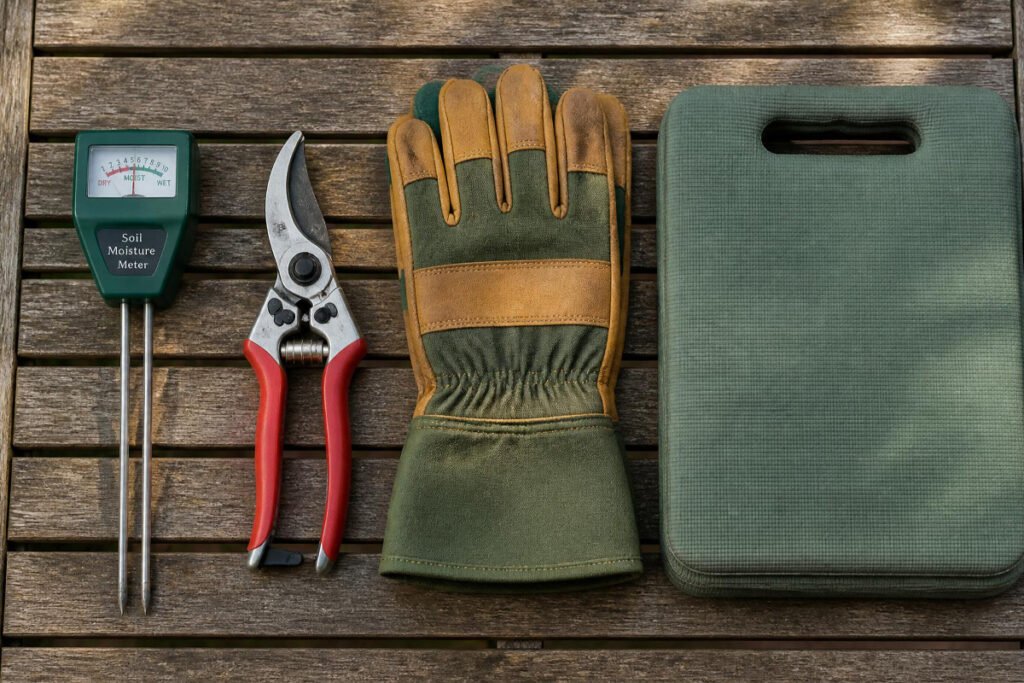
Table of Contents
- What Are Garden Gadgets & Accessories?
- How to Choose the Right Garden Gadget
- The 5 Best Garden Gadgets & Accessories
- Comparison Table
- Best Gadgets for Different Garden Types
- How to Get the Most Out of Your New Gadgets
- Common Mistakes
- Expert Tips
- Final Thoughts
- Frequently Asked Questions
What Are Garden Gadgets & Accessories? {#what-are-garden-gadgets}
“Garden gadgets” is a broad label, but the useful ones tend to fall into two camps: measurement tools that replace guesswork with data (moisture meters, smart timers), and comfort and precision tools that make repetitive tasks faster and less punishing on your body (kneelers, pruning shears, protective gloves). Neither category is about buying more stuff for its own sake — the goal is fewer dead plants and fewer sore knees.
If you’re building good habits from the ground up, it helps to pair these tools with solid fundamentals. Our guide to companion planting and our crop rotation guide both cover the kind of planning that makes any gadget more effective, because a moisture meter can’t compensate for the wrong plant in the wrong bed.
How to Choose the Right Garden Gadget {#how-to-choose}
Ask yourself three questions before buying anything on this list:
- What’s actually failing right now? Wilting plants point to a watering tool; sore knees and blistered palms point to comfort gear.
- How much daily attention can you realistically give your garden? If you travel often, prioritize automation (smart timers) over manual tools that need daily checking.
- What’s your soil and bed size? A short-probe moisture meter is fine for containers, but raised beds and in-ground rows need a longer probe to reach the actual root zone.
For a broader look at matching tools to your specific setup, the University of Minnesota Extension’s home garden equipment guidance is a useful, non-commercial reference point when you’re comparing specs.
The 5 Best Garden Gadgets & Accessories {#best-gadgets}
1. Soil Moisture Meter (XLUX T10 or similar capacitive probe)
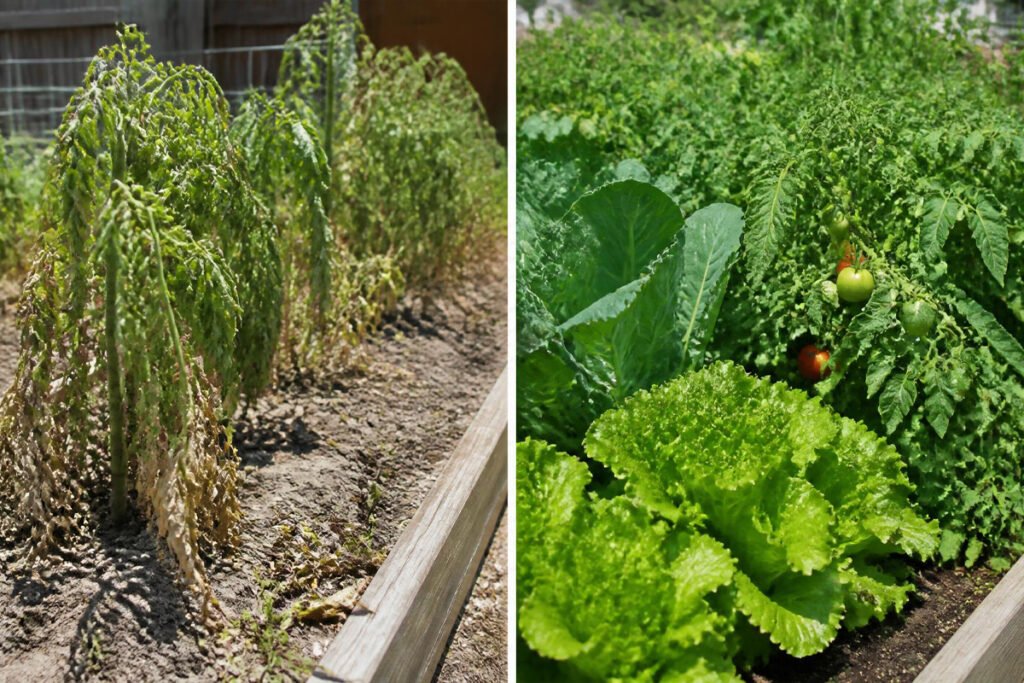
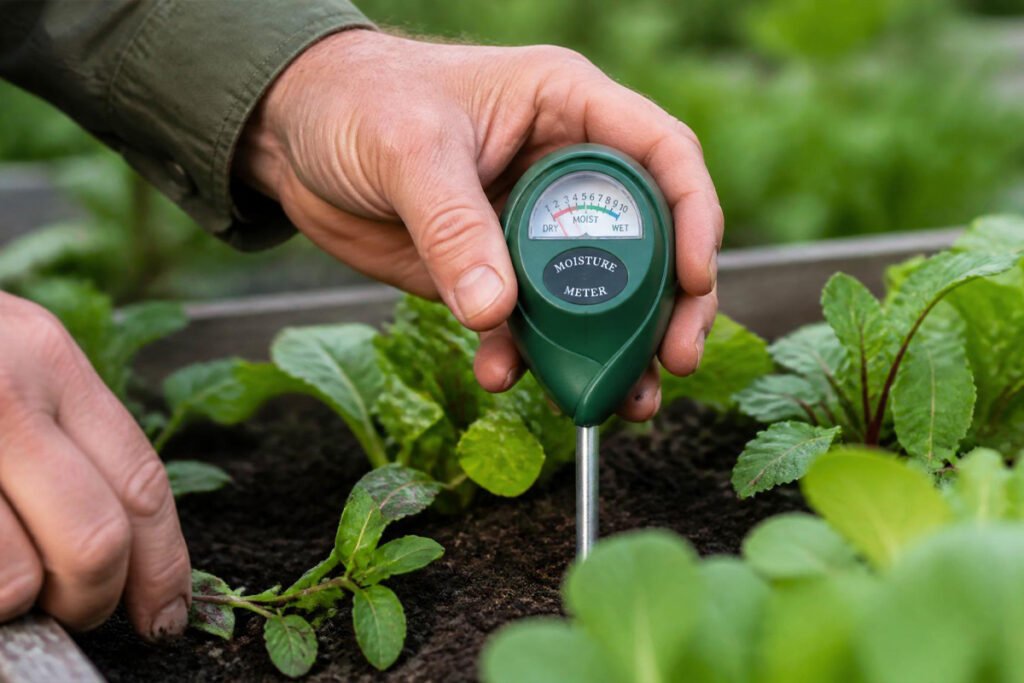
Overview: Overwatering, not neglect, is the single most common cause of plant death, and a soil moisture meter takes the guesswork out of deciding when to water. The XLUX T10 is widely cited across gardening review sites as the go-to budget pick, largely because it needs no batteries and has racked up an enormous number of user ratings for reliability.
Key Features:
- No batteries required — reads soil moisture instantly via a simple analog dial
- Color-coded scale (dry / moist / wet) that’s easy to read at a glance
- Standard 8–10 inch probe, suitable for most raised beds and containers
- Works across most soil types with basic personal calibration
Best For: Vegetable beds, containers, and gardeners who want a fast answer without an app or subscription.
Pros: ✅ Extremely affordable ✅ Zero maintenance or charging ✅ Instant readings
Cons: ❌ Not app-connected, so no remote alerts ❌ Shorter probes can give misleading readings in deep containers or compost piles
Our Verdict: For most home gardeners, a simple analog meter like this solves 90% of the watering-guesswork problem for very little money. If you’re growing in raised beds specifically, pair it with our raised bed gardening guide to dial in watering depth alongside soil mix.
2. Bypass Pruning Shears (Fiskars Softgrip Bypass Pruner)
Overview: A dull or mismatched pair of shears crushes stems instead of cutting them cleanly, which opens plants up to disease and slows healing. The Fiskars Softgrip Bypass Pruner consistently comes up as the best value pick in independent testing, cutting thicker branches more cleanly than most tools in its price range.
Key Features:
- Precision-ground steel blade with a low-friction coating that resists sap buildup
- Padded, non-slip handle grip
- Locking mechanism to keep blades closed in storage
- Handles stems and branches up to roughly ⅝ inch in diameter
Best For: General pruning, deadheading, and light branch work on shrubs, roses, and vegetable plants.
Pros: ✅ Sharp, clean cuts even on thicker stems ✅ Comfortable for extended use ✅ Budget-friendly compared to professional-grade brands
Cons: ❌ Thin handle profile can feel less comfortable during heavy hardwood cutting ❌ Not designed for branches beyond its rated diameter
Our Verdict: For the price, this is the shear most home gardeners should own before upgrading to anything more specialized. If your garden includes fruit-bearing plants, a clean cut also matters for the seasonal work covered in our tomato growing guide.
3. Garden Kneeler and Seat (Abco Tech-style dual kneeler/seat)
Overview: Weeding and planting done from a crouch adds up fast, and a dual-purpose kneeler-and-seat is one of the few gadgets nearly every reviewer agrees is worth owning. The frame flips between a padded kneeling surface and a raised seat, with side handles that double as support for standing back up.
Key Features:
- Thick foam pad that cushions knees on hard or wet ground
- Sturdy metal frame that converts between kneeler and seat
- Side handles for stability getting up and down
- Some models include tool storage pouches
Best For: Extended weeding, planting, and any task done at ground level, especially for gardeners managing knee or back discomfort.
Pros: ✅ Genuinely reduces joint strain ✅ Doubles as a seat for detail work ✅ Foldable for storage
Cons: ❌ Bulkier to carry around a large garden than a simple foam pad ❌ Tool pouches on cheaper models can be flimsy
Our Verdict: If you only add one comfort gadget this season, this is the one most gardeners notice immediately. It pairs naturally with any bed-prep work described in our companion planting guide.
4. Smart WiFi Hose Timer (Orbit B-hyve or Rachio Smart Hose Timer)
Overview: A smart hose timer screws onto your outdoor spigot and turns a standard hose into a scheduled, weather-aware watering system — without the cost or installation of an in-ground sprinkler controller. Both the Orbit B-hyve and Rachio versions check local weather and automatically skip or delay watering before rain, which cuts down on wasted water.
Key Features:
- WiFi hub for remote scheduling and manual on/off from your phone
- Automatic rain delay based on local weather data
- Compatible with drip irrigation kits, soaker hoses, and standard sprinklers
- Multi-zone models allow independent schedules for different beds
Best For: Gardeners who travel, anyone tired of manually adjusting hose timing, and multi-bed setups that need different watering schedules.
Pros: ✅ Genuinely reduces water waste ✅ Works with existing hoses and drip lines ✅ Remote control from anywhere
Cons: ❌ Requires WiFi setup and an indoor hub ❌ More expensive upfront than a mechanical timer
Our Verdict: This is the highest-impact upgrade for anyone whose garden struggles most when they’re not home to water it manually. It complements the watering fundamentals in our backyard watering systems guide.
5. Puncture-Resistant Gauntlet Gardening Gloves
Overview: Standard nitrile gloves wear out fast and offer little protection against thorns, brambles, or rose canes. Gauntlet-style gloves with leather or reinforced synthetic palms and an elbow-length cuff solve this specifically, and they’re consistently the top recommendation for anyone working around roses, blackberries, or other thorny plants.
Key Features:
- Cowhide or reinforced synthetic leather palm for puncture resistance
- Elbow-length gauntlet cuff to protect forearms from thorns and scratches
- Breathable mesh or spandex back panel for comfort in warm weather
- Reinforced fingertips and adjustable cuffs on most models
Best For: Pruning roses, brambles, or any thorny plant, plus general heavy-duty yard work.
Pros: ✅ Genuine thorn and puncture protection ✅ Forearm coverage that standard gloves lack ✅ Long-lasting compared to disposable nitrile gloves
Cons: ❌ Bulkier and less dexterous than thin gardening gloves ❌ Leather versions need occasional conditioning to stay flexible
Our Verdict: Worth the upgrade the moment thorny plants enter your garden. If you’re expanding into pollinator-friendly plantings, several popular choices do include thorned shrubs, so see our pollinator-friendly plants guide for what you might be handling.
Comparison Table {#comparison-table}
| Gadget | Best For | Price Range | Skill Level | Upkeep |
|---|---|---|---|---|
| Soil Moisture Meter | Watering accuracy | Budget | Beginner | None |
| Bypass Pruning Shears | Clean, healthy cuts | Budget–Mid | All levels | Occasional sharpening |
| Kneeler & Seat | Comfort during ground-level work | Mid | All levels | None |
| Smart WiFi Hose Timer | Automated, weather-aware watering | Mid–Premium | Beginner | Occasional app setup |
| Gauntlet Gardening Gloves | Thorn and puncture protection | Budget–Mid | All levels | Occasional leather care |
Best Gadgets for Different Garden Types {#garden-types}
Small Space & Container Gardens
A short-probe soil moisture meter and a compact pair of pruning snips go the furthest here — bulkier gear like a full kneeler often isn’t necessary in a small container setup. If space is tight, our vertical gardening guide pairs well with lightweight tool choices.
Raised Bed Vegetable Gardens
This is where a longer-probe moisture meter and a smart hose timer earn their keep, since raised beds dry out faster than in-ground soil. Combine both with the fundamentals in our raised bed gardening guide and our composting bins guide for soil health.
Larger Backyard & Ornamental Gardens
Bigger properties benefit most from a multi-zone smart hose timer and a proper kneeler-and-seat, since more ground means more time spent watering and weeding. See our backyard garden renovation guide for how these tools fit into a larger redesign.
How to Get the Most Out of Your New Gadgets {#how-to-use}
Step 1: Identify Your Biggest Pain Point
Don’t buy all five gadgets at once. Start with whichever problem is costing you the most plants or the most physical discomfort.
Step 2: Calibrate Before You Trust It
Soil moisture meters in particular need a quick personal calibration — check the reading right after watering (your “wet” baseline) and again when a plant starts to wilt (your “dry” baseline), since raw percentages vary by soil type.
Step 3: Match the Tool to the Task
Use bypass shears for green, living stems and save anvil-style tools for dead wood — using the wrong type is one of the most common reasons pruning tools feel underwhelming.
Step 4: Build a Simple Routine
Set a smart hose timer’s base schedule, then let its weather-delay feature handle the exceptions rather than manually overriding it every time rain is forecast.
Step 5: Maintain What You Buy
Clean and lightly oil pruning shear blades after use, and let foam kneeler pads dry fully before storage to prevent mildew.
Common Mistakes {#common-mistakes}
Buying a moisture meter with too short a probe. A surface reading on a deep raised bed or large container can show “dry” while the actual root zone is still saturated. Check probe length against your bed depth before buying, a point we also cover in our raised bed guide.
Using anvil pruners on living stems. Anvil-style blades crush rather than cleanly slice green growth, which can invite disease. Save them strictly for dead wood and reach for bypass shears everywhere else.
Setting a smart hose timer once and forgetting it. Schedules that made sense in spring often overwater in the cooler days of fall. Revisit your timer settings seasonally, and cross-check against the watering guidance in our efficient watering techniques guide.
Expert Tips {#expert-tips}
Calibrate by feel, not just the dial. Even a good moisture meter reads soil types differently — sandy soil “reads” moist for a shorter window than clay. Cross-reference readings with an actual finger test for the first few weeks.
Keep two pairs of gloves in rotation. A lightweight pair for everyday weeding and a gauntlet pair for thorny work means you’re never tempted to skip protection because the “good” gloves are dirty.
Group gadgets by task, not by shelf. Store your moisture meter, shears, and gloves together near your most-used bed rather than in a general toolbox — the friction of walking to get a tool is often why it goes unused.
Final Thoughts {#final-thoughts}
Best overall: the soil moisture meter, for the sheer amount of guesswork it removes for almost no money. Best for comfort: the kneeler and seat, which nearly every long-time gardener wishes they’d bought sooner. Best for busy schedules: a smart WiFi hose timer, especially if you travel or manage more than one growing area. Best for thorny plants: gauntlet gloves, which solve a problem no standard glove addresses. Whichever you start with, pair it with solid growing fundamentals — our companion planting guide and how to grow herbs indoors guide are good next reads.
Frequently Asked Questions {#faq}
Do I really need a soil moisture meter, or can I just check by hand? You can absolutely check by hand for surface soil, but a meter is far more reliable for anything deeper than a couple of inches — which is exactly where root zones actually sit in raised beds and containers.
How long do bypass pruning shears typically last? A well-maintained pair from a mainstream brand can last 8–15 years with regular cleaning and occasional sharpening; premium professional-grade shears can last decades since their parts are individually replaceable.
Smart hose timer vs. a basic mechanical timer — which should I get? A mechanical timer is cheaper and works fine for a single, consistent schedule. A smart WiFi timer costs more but pays for itself through automatic weather-based adjustments if your schedule needs to flex with the seasons.
My gauntlet gloves feel stiff — is that normal? Leather gauntlet gloves often feel stiff out of the box and soften with use; occasional leather conditioner can speed this up without compromising puncture resistance.
Can I use a garden kneeler on grass and concrete equally well? Most foam-padded kneelers work fine on both, though soft ground can cause metal-legged frames to sink slightly — look for wider feet if your garden is mostly lawn.
Is it safe to leave a smart hose timer connected outdoors year-round? Most models are weatherproof for three-season use, but manufacturers generally recommend disconnecting and draining the unit before hard freezes to avoid damage to internal valves.
What’s the difference between bypass and anvil pruners? Bypass shears cross like scissors and give a clean cut on living stems; anvil shears close onto a flat base and are better reserved for already-dead wood, since they tend to crush green growth.
Do I need different gloves for different seasons? A lighter breathable glove is more comfortable for warm-weather weeding, while a leather gauntlet glove is more useful whenever you’re handling thorny prune-backs, regardless of season.
How deep should a soil moisture meter probe go for raised beds? Aim for a probe that reaches at least 8–10 inches for standard raised beds, and closer to 12–15 inches for deeper beds or compost piles, since surface readings alone can be misleading.
Are budget garden gadgets worth it, or should I buy premium from the start? For most home gardeners, mid-range, well-reviewed options like the ones featured here offer the bulk of the benefit at a fraction of professional-grade pricing — reserve premium upgrades for tools you use daily.
Author: Pamela Reese Last Updated: July 2026