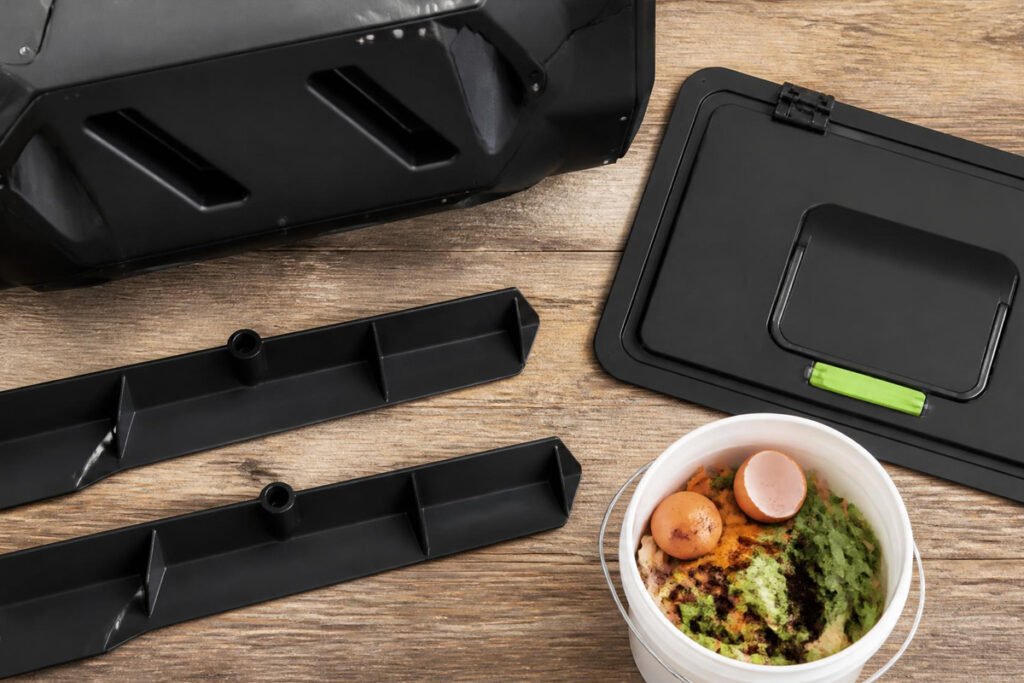
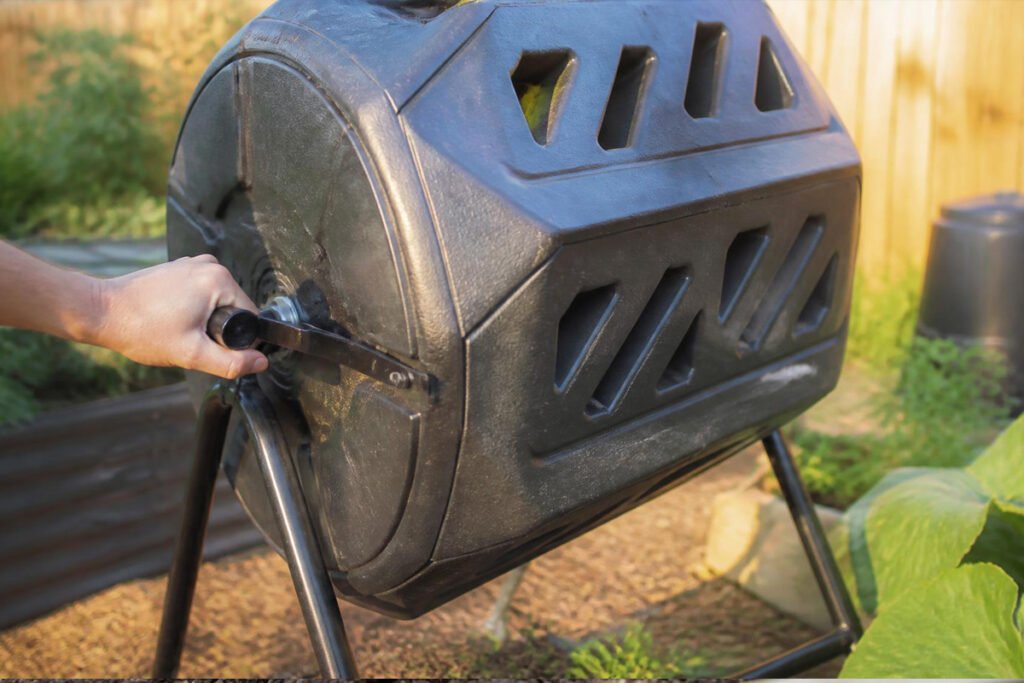
A traditional compost pile works, but it works slowly, and it needs regular pitchforking to keep oxygen moving through the material — skip that turning, and you end up with a soggy, smelly heap instead of the crumbly, dark compost you were hoping for. A compost tumbler solves both problems at once: a sealed, rotating drum that mixes and aerates the contents with a simple spin, no pitchfork required, while also keeping pests out and odor contained far better than an open pile.
This guide compares the best compost tumblers for 2026, from dual-chamber systems built for continuous composting to compact single-chamber models perfect for a first attempt. If you already have a stationary setup, this is a genuinely different tool than what we cover in our composting bins guide — tumblers trade some capacity for speed and far less physical effort.
Quick Picks
| If you need… | Best pick |
|---|---|
| Best overall, most proven | FCMP Outdoor IM4000 (Dual Chamber) |
| Best for beginners & small yards | YIMBY Tumbler Composter |
| Best for patios & compost tea | Envirocycle |
| Best trusted full-featured brand | Miracle-Gro Dual Chamber Composter |
| Best budget alternative | VIVOSUN Compost Tumbler |
| Best for cold climates | Joraform JK125 (Insulated) |
Tumbler vs. Open Pile: What’s the Real Difference?
Composting is fundamentally about oxygen, moisture, and a balance of “green” (nitrogen-rich) and “brown” (carbon-rich) material — a tumbler doesn’t change the chemistry, it just makes managing it dramatically easier. Turning an open pile with a pitchfork is physical work and easy to skip, which is exactly why so many home compost piles stall out half-finished. A tumbler’s sealed rotation does the mixing in seconds with a single spin, which is also why tumblers finish compost meaningfully faster than open piles — typically 4–8 weeks under good conditions versus 3–12 months for an untended pile.
The trade-off is capacity and cost: tumblers hold less material per unit than a large open bin system, and a quality tumbler costs more upfront than a simple wire or wood bin. For most home gardeners producing a moderate, steady stream of kitchen and yard scraps, that trade is well worth it.
How to Choose the Right Compost Tumbler
Before buying, consider:
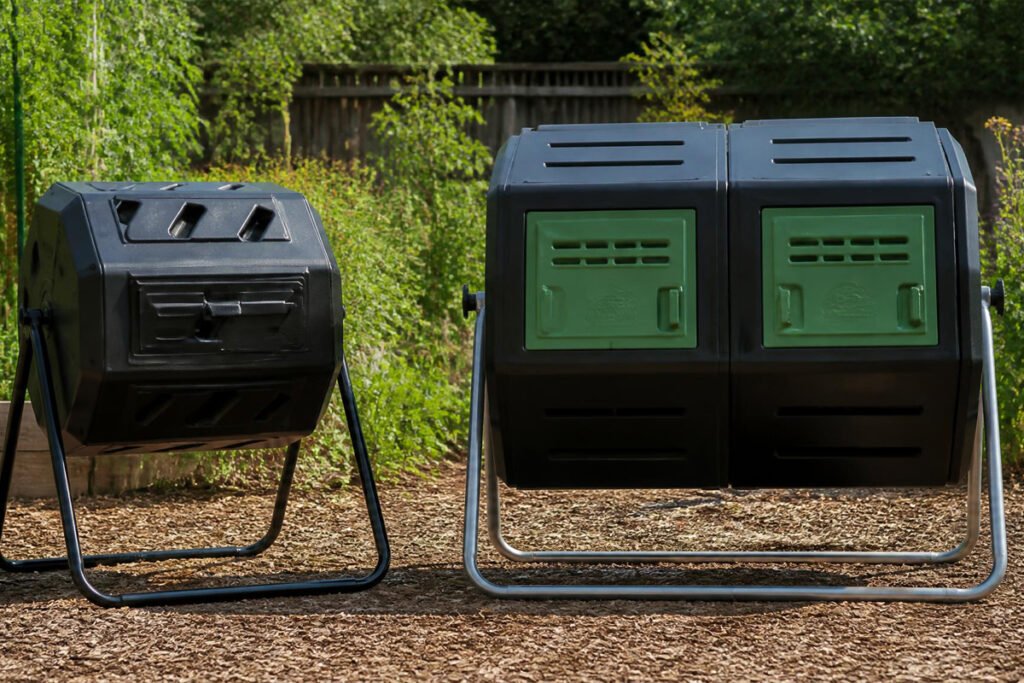
- Single vs. dual chamber. A single-chamber tumbler forces a choice once it’s full: stop adding fresh material until the batch finishes, or harvest unfinished compost. A dual-chamber design solves this directly — seal one side to finish while you keep filling the other, so you’re never stuck waiting.
- Capacity for your household. A small household producing modest kitchen scraps does fine with a compact single-chamber tumbler. A larger household or anyone composting yard waste too will fill a small tumbler faster than expected and benefit from more total capacity.
- Climate. Cold climates slow decomposition significantly. If you compost through winter, an insulated tumbler retains heat far better than a standard uninsulated drum, keeping the process active even in colder months.
Best Compost Tumblers Available
1. FCMP Outdoor IM4000 (Dual Chamber)
Overview: With over 11,500 five-star reviews, the FCMP IM4000 is the most tested and trusted tumbler in this category, and its dual-chamber design is the specific reason experienced composters tend to land here after trying something else first. Two 18.5-gallon chambers let you seal one side to finish while continuing to fill the other, so you’re never forced to pause adding scraps.
Key Features:
- Two 18.5-gallon chambers (37 gallons total) for continuous composting
- 8 deep internal fins for thorough mixing with each turn
- Elevated stand, dark drum for solar heat absorption
- Made from recycled, BPA-free, UV-resistant plastic
Best For: Households that generate a steady stream of kitchen and yard scraps and want to compost continuously without gaps.
Pros: ✅ Never have to pause adding fresh material ✅ Extensively tested and reviewed ✅ Solar heat absorption speeds decomposition Cons: ❌ Smaller access door makes larger yard waste awkward to add ❌ Assembly takes roughly 1–2 hours
Our Verdict: If you only buy one compost tumbler, this is the one most serious home composters end up with — the dual-chamber design solves the single biggest frustration with tumbler composting.
2. YIMBY Tumbler Composter
Overview: For a first attempt at composting, the YIMBY strips things down to the essentials — lightweight enough to spin with one hand even when full, compact enough for a small yard or side patio, and priced as the entry point into this category rather than a long-term investment.
Key Features:
- Compact single-chamber design
- Genuinely lightweight, easy to spin even when full
- Simple, straightforward assembly
- Lowest price point in this roundup
Best For: First-time composters who want to confirm the habit sticks before investing in a larger system.
Pros: ✅ Very easy to use and spin ✅ Compact footprint for small spaces ✅ Affordable entry point Cons: ❌ Single chamber means you can’t add fresh material to an active batch ❌ Smaller capacity limits it to lighter composting needs
Our Verdict: Multiple gardeners who started here report upgrading to a dual-chamber system after a season — not because the YIMBY failed, but because it worked well enough to justify more capacity.
3. Envirocycle
Overview: Built specifically for urban gardeners and patio growers, the Envirocycle pairs an attractive, rust-proof aluminum frame with a genuinely useful bonus feature: a built-in tea collection base that captures nutrient-rich liquid runoff as compost tea, a byproduct standard tumblers simply lose.
Key Features:
- Compact cylindrical design suited to patios and small yards
- Rust-proof aluminum frame
- Built-in compost tea collection base
- Optimized airflow for efficient decomposition
Best For: Urban and patio gardeners who want both finished compost and usable liquid compost tea from the same system.
Pros: ✅ Attractive design that fits smaller spaces ✅ Genuinely useful compost tea byproduct ✅ Efficient oxygen flow speeds decomposition Cons: ❌ Premium price versus basic tumblers ❌ Smaller capacity than large dual-chamber systems
Our Verdict: If space is limited and you’d get real use out of liquid compost tea for container plants, the premium price here is genuinely justified — pairs naturally with a container or grow bag garden.
4. Miracle-Gro Dual Chamber Composter
Overview: From a garden brand most people already trust, this dual-chamber tumbler covers essentially every feature a home composter could want — oxygen inlets, a rotation-locking stopper for safe loading, and generously sized doors for adding material without a struggle.
Key Features:
- Dual-chamber design for continuous composting
- Adjustable oxygen inlets for airflow control
- Locking stopper holds rotation in place while loading or unloading
- Large access doors, plus included gardening gloves
Best For: Gardeners who want a full-featured tumbler from an established, familiar brand name.
Pros: ✅ Comprehensive feature set ✅ Large doors simplify loading and harvesting ✅ Trusted, well-known brand Cons: ❌ Similar price to FCMP without a significantly larger track record ❌ Some assembly required, similar to competitors
Our Verdict: A strong alternative to the FCMP if brand familiarity matters to you — the feature set is comparable, and the included gloves are a nice practical touch.
5. VIVOSUN Compost Tumbler
Overview: VIVOSUN brings its reputation for solid, affordable garden equipment to composting with a straightforward dual-chamber tumbler that covers the core functionality at a lower price point than premium competitors.
Key Features:
- Dual-chamber design for continuous composting
- Sturdy stand construction
- Ventilation holes for consistent airflow
- Budget-friendly pricing for dual-chamber functionality
Best For: Gardeners who want dual-chamber convenience without paying premium prices for it.
Pros: ✅ Dual-chamber functionality at a lower price ✅ Solid, functional build ✅ Good airflow design Cons: ❌ Fewer refinements than premium models like added tea collection ❌ Slightly narrower track record than FCMP or Miracle-Gro
Our Verdict: If budget is the deciding factor but you still want the continuous-composting benefit of dual chambers, this is the practical middle ground.
6. Joraform JK125 (Insulated)
Overview: Standard tumblers slow down dramatically in cold weather, which is exactly the problem the Joraform’s insulated double-wall design solves — retaining internal heat well enough to keep decomposition active through winter months that would stall an uninsulated drum entirely.
Key Features:
- Insulated double-wall construction retains internal heat
- Designed for year-round composting, including cold climates
- Durable, weather-resistant materials
- Sized for smaller households (with a larger JK270 model available)
Best For: Gardeners in cold climates who want to keep composting active through winter rather than pausing until spring.
Pros: ✅ Genuinely functional in cold weather ✅ Durable, long-lasting construction ✅ Available in multiple sizes Cons: ❌ Higher price reflects the insulated construction ❌ Heavier than standard uninsulated tumblers
Our Verdict: If winter has ever brought your composting to a complete standstill, the insulation here solves that specific problem rather than working around it.
Comparison Table
| Tumbler | Best For | Chambers | Capacity | Notable Feature |
|---|---|---|---|---|
| FCMP IM4000 | Overall, most proven | Dual | 37 gal total | Extensive review track record |
| YIMBY | Beginners, small yards | Single | Compact | Lightest, easiest to spin |
| Envirocycle | Patios, compost tea | Single | Compact | Built-in tea collection |
| Miracle-Gro Dual | Full features, trusted brand | Dual | Comparable to FCMP | Locking stopper, large doors |
| VIVOSUN | Budget dual-chamber | Dual | Comparable | Lower price for the feature set |
| Joraform JK125 | Cold climates | Single | Smaller household | Insulated for winter use |
Best Tumblers for Different Situations
First-Time Composters
Start with a compact, easy-to-spin option like the YIMBY to confirm the habit sticks before investing in a larger dual-chamber system — most people who upgrade do so because it worked, not because it failed.
Ongoing, Continuous Composting
A dual-chamber tumbler like the FCMP IM4000 or Miracle-Gro is worth the investment once you’re generating a steady stream of scraps, since you’ll never have to pause adding material while a batch finishes.
Feeding Container Gardens
The Envirocycle’s compost tea byproduct is a genuine bonus if you’re growing in grow bags or containers that benefit from regular liquid feeding alongside solid compost.
Common Mistakes
- Skipping regular tumbling. The whole advantage of a tumbler is aeration through movement — spin it every 2–3 days for the fastest results. Neglect it, and you lose most of the speed advantage over an open pile.
- Getting the green-to-brown ratio wrong. Too much wet, nitrogen-rich material (green) without enough dry, carbon-rich material (brown) leads to a soggy, smelly batch even in a sealed tumbler. Balance kitchen scraps with dried leaves, shredded paper, or straw.
- Overfilling a single-chamber tumbler. Leaving no room for material to actually tumble and mix defeats the purpose. Fill to roughly three-quarters capacity, not completely full.
Expert Tips
- Kickstart a new batch with a few shovelfuls of finished compost or garden topsoil. This introduces an active microbial colony that speeds up decomposition from day one, rather than waiting for microbes to establish naturally.
- Chop larger scraps before adding them. Smaller pieces break down significantly faster in a tumbler than whole fruit rinds or thick branches, since surface area matters more than volume.
- Track roughly how long each batch takes in your specific conditions, since real timing varies by season, tumbler type, and how consistently you turn it — this helps you plan when to expect finished compost for spring planting alongside your organic fertilizers routine.
Final Thoughts
Best overall: The FCMP IM4000’s dual-chamber design and extensive track record make it the tumbler most serious home composters land on. Best for beginners: The YIMBY is the easiest, lowest-commitment way to confirm composting is a habit worth sticking with. Best for patios: The Envirocycle’s compact size and compost tea byproduct make it a genuinely useful pick for container and small-space gardeners.
Whichever you choose, remember that finished compost is only half the equation — pair it with the guidance in our organic fertilizers and soil amendments guide and work it into your raised beds or containers for the full benefit.
Frequently Asked Questions
Is a compost tumbler really faster than a traditional pile? Yes, significantly. Under good conditions, tumblers can produce finished compost in 4–8 weeks, compared to 3–12 months for an untended open pile, largely because the sealed rotation makes consistent aeration effortless.
Single-chamber or dual-chamber — which should I get? If you’re just starting out or have modest composting needs, a single-chamber tumbler is simpler and cheaper. If you generate a steady stream of scraps, a dual-chamber design lets you keep adding fresh material continuously instead of pausing while a batch finishes.
How often should I turn a compost tumbler? Turning every 2–3 days gives the fastest results under warm conditions. Less frequent turning still works, just more slowly — the tumbler will still outperform an untended pile even with occasional spins.
Can I compost through winter in a tumbler? Standard tumblers slow down significantly in cold weather since decomposition depends partly on internal temperature. An insulated model like the Joraform retains heat better and keeps the process meaningfully active through colder months.
What can and can’t go in a compost tumbler? Fruit and vegetable scraps, coffee grounds, eggshells, yard clippings, and dried leaves work well. Avoid meat, dairy, oily foods, and pet waste, which can attract pests and create odor even in a sealed tumbler.
Do I need to add a compost starter? It’s not strictly necessary, but a few shovelfuls of finished compost or rich garden soil introduces active microbes that speed up the early stages of decomposition, especially for a brand-new tumbler with no established microbial activity.
Why does my compost tumbler smell bad? This is almost always a green-to-brown imbalance — too much wet, nitrogen-rich material without enough dry, carbon-rich material. Adding dried leaves, shredded paper, or straw and turning more frequently usually resolves it.
How much compost does a typical household actually produce? It varies widely based on kitchen scraps and yard waste generated, but a dual-chamber 35–40 gallon tumbler comfortably handles the needs of most households without constant harvesting.
Is compost tea from a tumbler like the Envirocycle actually useful? Yes — the liquid runoff carries nutrients from the decomposing material and, diluted appropriately, works as a mild liquid fertilizer for container plants, similar in spirit to products in our organic fertilizers guide.
Are compost tumblers worth it compared to a simple bin? For most home gardeners, yes — the speed and reduced physical effort are a real upgrade over managing an open pile or basic bin with a pitchfork. Bins still make sense for larger-volume composting where tumbler capacity would be limiting; see our composting bins guide for that comparison.
Author: Pamela Reese Last Updated: August 2026