Watering can in one hand, fertilizer or pest treatment in the other — at some point every gardener realizes hand-application just doesn’t cover ground evenly. A garden sprayer solves that by turning liquid fertilizer, organic pest treatments, and weed killers into a fine, even mist that covers plants without the guesswork of pouring or splashing. But not every sprayer suits every job: a 1-gallon handheld is perfect for a few containers, while a full vegetable garden or backyard needs the capacity of a backpack model.
This guide compares the best garden sprayers for 2026, from compact pump sprayers to battery-powered backpacks. If you’re using yours for pest treatments, pair it with our organic pest control guide, and for liquid feeding, see our organic fertilizers and soil amendments guide.
Quick Picks
| If you need… | Best pick |
|---|---|
| Best overall value | Chapin 20000 1-Gallon Pump Sprayer |
| Large garden or yard coverage | Chapin 61900 4-Gallon Backpack Sprayer |
| Compact, precise spot-treatment | Solo 418 One-Hand Pressure Sprayer |
| Heavy-duty backpack for regular use | Solo 425 4-Gallon Backpack Sprayer |
| No-pumping, battery-powered ease | Scotts Battery-Powered Handheld Sprayer |
| Extended reach for tall or dense plants | PetraTools HD101 (long hose) |
| Everyday multi-purpose tank | Chapin 2-Gallon SureSpray Sprayer |
How Garden Sprayers Actually Work
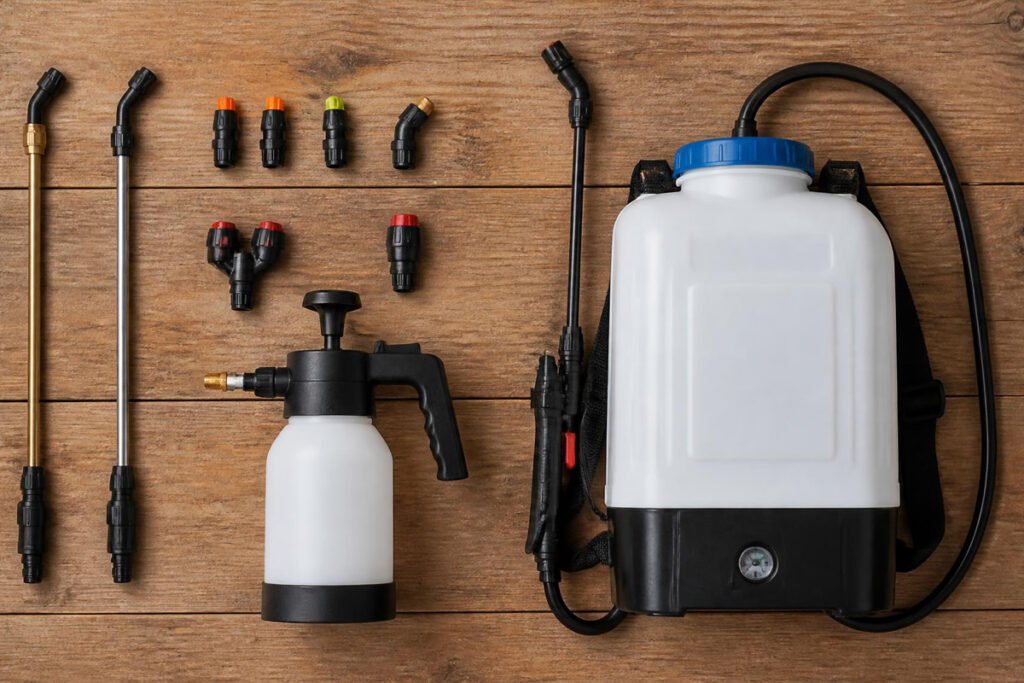
Most garden sprayers use one of two mechanisms. Manual pump sprayers rely on a hand pump to pressurize the tank, which then pushes liquid out through an adjustable nozzle — you build pressure with a lever before spraying, and periodically re-pump as pressure drops. Battery-powered sprayers use an internal motor to maintain consistent pressure automatically, eliminating the pumping entirely, which matters if you’re treating a large area or have limited grip strength.
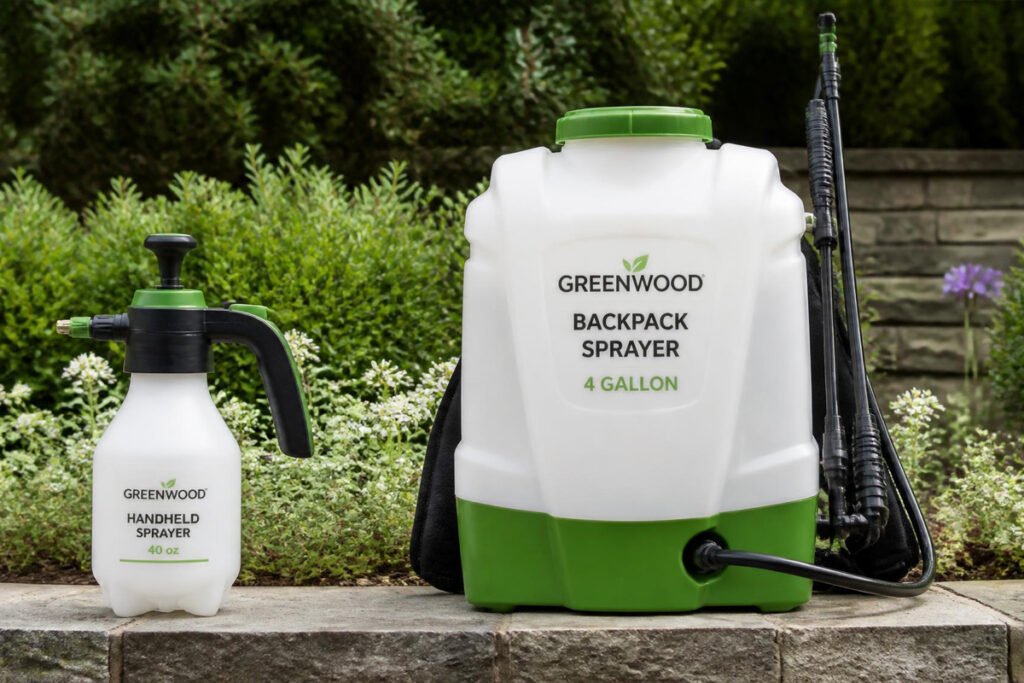
Capacity and wearability matter as much as the mechanism. A 1-gallon handheld is light enough to carry one-handed but needs refilling often; a 4-gallon backpack covers far more ground per fill but adds real weight on your shoulders. Nozzle type matters too — fan nozzles spread coverage over a wide area, cone nozzles suit general garden use, and stream nozzles target individual weeds or hard-to-reach spots.
How to Choose the Right Sprayer
Before buying, ask:
- How much area am I covering? A handful of containers or a small raised bed rarely justifies more than 1–2 gallons. A full backyard or vegetable garden benefits from a 4-gallon backpack.
- What am I spraying? Water and mild organic treatments work fine in any sprayer; stronger chemical concentrates need a sprayer rated for chemical resistance, with nitrile seals rather than standard rubber.
- Do I want to pump, or not? Manual pumping is reliable and needs no charging, but it’s genuine physical effort over a large area. Battery-powered models trade a charging step for significantly less fatigue.
Whatever sprayer you choose, dedicate it to one category of use — plain water/fertilizer versus herbicides, for instance — and rinse thoroughly after every use, since sprayer residue is one of the more common causes of accidental plant damage from cross-contamination.
Best Garden Sprayers Available
1. Chapin 20000 1-Gallon Lawn and Garden Sprayer
Overview: The Chapin 20000 is the most popular pump sprayer on the market for a reason — a compact 1-gallon translucent poly tank, an in-tank anti-clog filter, and a 34-inch hose that covers most home gardening tasks without any complexity.
Key Features:
- 1-gallon translucent poly tank with funnel-top opening
- In-tank anti-clog filter for reliable performance
- Adjustable cone nozzle (stream to wide spray)
- 12-inch poly wand plus 34-inch hose for reach
Best For: Everyday fertilizing, pest treatments, and weed spot-treatment in home gardens.
Pros: ✅ Affordable and widely available ✅ Reliable, consistent spray pattern ✅ Easy to clean and maintain Cons: ❌ 1-gallon capacity means frequent refills for larger areas ❌ Manual pumping required throughout use
Our Verdict: If you only buy one sprayer, this is the sensible starting point — it covers the majority of everyday tasks from weed control to liquid feeding without overcomplicating things.
2. Chapin 61900 4-Gallon Manual Backpack Sprayer
Overview: When ground coverage matters more than portability, the Chapin backpack steps up capacity fourfold while distributing weight across padded shoulder straps instead of one arm. It’s built for gardeners treating a full yard or large vegetable plot in a single session.
Key Features:
- 4-gallon tank capacity — a full afternoon’s worth of coverage
- Padded, adjustable shoulder straps
- Multiple nozzle options for different spray patterns
- Pressure-regulating valve for even application
Best For: Large gardens, orchards, or yards where refilling a 1-gallon sprayer repeatedly isn’t practical.
Pros: ✅ Covers significantly more area per fill ✅ Comfortable for extended sessions ✅ Reliable, even application Cons: ❌ Heavy once full, especially on the shoulders ❌ Overkill for small container or raised bed gardens
Our Verdict: A genuine time-saver if you’re treating anything beyond a handful of beds — the extra capacity means far fewer trips back to refill.
3. Solo 418 One-Hand Pressure Sprayer
Overview: For quick, precise spot-treatments — a single problem plant, a patch of weeds, a few pots — the Solo 418’s compact 1-liter tank and ergonomic one-hand grip make it the most convenient option in this lineup, with a lock-on trigger that reduces hand fatigue during use.
Key Features:
- Compact 1-liter tank, genuinely one-hand operable
- Lock-on trigger for extended spraying without a constant squeeze
- Ergonomic, comfortable grip
- Drift/drip guards for more controlled application
Best For: Small-scale spot treatments, container gardens, and quick jobs that don’t justify a full-size sprayer.
Pros: ✅ Extremely convenient for quick tasks ✅ Comfortable one-hand design ✅ Precise, controlled spray Cons: ❌ Small tank size limits it to light-duty use ❌ Not suited for treating large areas
Our Verdict: A smart second sprayer to keep on hand for the small jobs where hauling out a full tank feels like overkill — spot-treating pests noticed while walking your raised beds, for example.
4. Solo 425 4-Gallon Backpack Sprayer
Overview: Solo has built commercial-grade sprayers for decades, and the 425 reflects that — a manual diaphragm pump capable of up to 60 PSI, five interchangeable nozzles, and construction rated for stronger concentrates like wettable powders that can damage lesser sprayers.
Key Features:
- Manual diaphragm pump, up to 60 PSI
- Five included nozzles for varied application needs
- Rated for concentrates, wettable powders, and stronger treatments
- Padded shoulder straps and control-flow valve
Best For: Gardeners who need a sprayer rated for stronger treatments, not just water-based mixes.
Pros: ✅ Handles a wider range of treatment types ✅ Excellent spray consistency ✅ Durable, commercial-grade components Cons: ❌ Premium price versus basic backpack models ❌ Straps can dig in when the tank is at full capacity
Our Verdict: Worth the upgrade if you’re regularly applying anything beyond plain water-based fertilizer — the build quality and PSI rating are a real step up.
5. Scotts Professional Battery-Powered Handheld Sprayer
Overview: Manual pumping is the single biggest complaint about traditional sprayers, and Scotts solves it entirely with a rechargeable battery that maintains consistent pressure automatically — genuinely useful for anyone with limited grip strength or a larger area to cover without constant re-pumping.
Key Features:
- Rechargeable battery eliminates manual pumping
- Consistent pressure throughout the tank’s use
- Comfortable handheld design
- Multiple spray settings
Best For: Gardeners with limited hand or arm strength, or anyone who’d rather not pump throughout a long session.
Pros: ✅ No pumping required ✅ Consistent spray pressure ✅ Comfortable for extended use Cons: ❌ Requires charging between uses ❌ Higher price than manual equivalents
Our Verdict: If pumping a manual sprayer has ever left your hand sore, this solves that problem directly — a genuine quality-of-life upgrade for regular users.
6. PetraTools HD101 (Long-Hose Handheld Sprayer)
Overview: Tall shrubs, hanging baskets, and dense foliage are awkward to reach with a standard short-hose sprayer. The PetraTools HD101’s extended 52-inch hose and dual-nozzle system specifically solve the reach problem without needing a full backpack unit.
Key Features:
- Extended 52-inch hose for reaching tall or dense plants
- Dual nozzle system for switching spray patterns
- Moderate tank capacity, lighter than a backpack unit
- Comfortable pump handle
Best For: Fruit trees, tall shrubs, hanging baskets, and other hard-to-reach spraying targets.
Pros: ✅ Excellent reach without a backpack’s bulk ✅ Flexible nozzle options ✅ Good middle-ground capacity Cons: ❌ Long hose takes more effort to manage and store ❌ Still requires manual pumping
Our Verdict: If you’re treating vertical gardening setups or fruit trees where a short hose leaves you straining to reach, this is the practical solution.
7. Chapin 2-Gallon SureSpray Sprayer
Overview: Sitting between the compact 1-gallon and bulky backpack options, the Chapin 2-Gallon offers a genuine capacity upgrade while still being carried by hand or over one shoulder, making it a practical middle-ground for medium-sized gardens.
Key Features:
- 2-gallon poly tank, larger capacity than standard handhelds
- Anti-clog in-tank filter
- Adjustable cone nozzle, fine mist to focused stream
- Corrosion-resistant materials and nitrile seals
Best For: Medium gardens that have outgrown a 1-gallon sprayer but don’t need a full backpack.
Pros: ✅ Solid capacity-to-portability balance ✅ Nitrile seals handle common garden chemicals well ✅ Affordable Cons: ❌ Heavier to carry than the 1-gallon model ❌ Still requires periodic manual pumping
Our Verdict: A practical step up once you’re regularly refilling a 1-gallon sprayer mid-task — enough extra capacity to matter without backpack-level bulk.
Comparison Table
| Sprayer | Best For | Capacity | Power | Notable Feature |
|---|---|---|---|---|
| Chapin 20000 | Everyday use | 1 gal | Manual pump | Best overall value |
| Chapin 61900 | Large gardens | 4 gal | Manual pump (backpack) | High-capacity coverage |
| Solo 418 | Quick spot-treatments | 1 L | Manual pump | One-hand, lock-on trigger |
| Solo 425 | Stronger concentrates | 4 gal | Manual pump (backpack) | Rated for wettable powders |
| Scotts Battery | Reduced fatigue | Handheld size | Battery-powered | No manual pumping |
| PetraTools HD101 | Tall/hard-to-reach plants | Moderate | Manual pump | 52-inch hose |
| Chapin 2-Gallon | Medium gardens | 2 gal | Manual pump | Balance of capacity & portability |
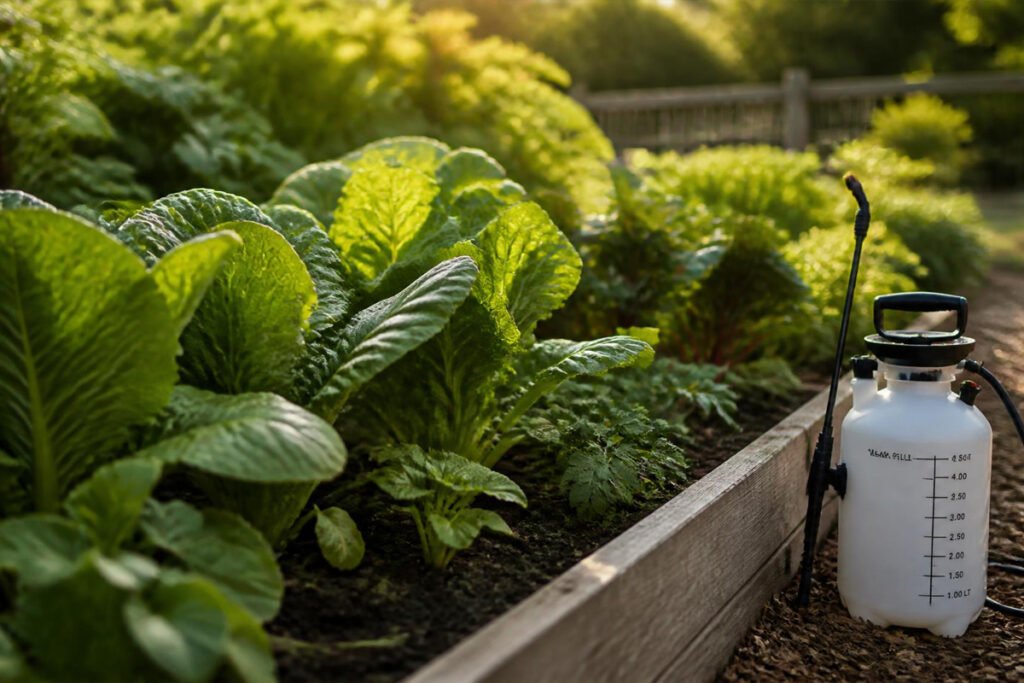
Best Sprayers for Different Garden Tasks
Organic Pest Control
A 1–2 gallon handheld sprayer, like the Chapin 20000 or 2-Gallon SureSpray, covers most home applications of the treatments in our organic pest control guide without excess bulk.
Liquid Fertilizing
Larger gardens benefit from backpack capacity so you’re not refilling mid-application — pair a 4-gallon backpack with the guidance in our organic fertilizers and soil amendments guide for consistent, full-coverage feeding.
Weed Spot-Treatment
Precision matters more than volume here. A compact sprayer with a stream nozzle, like the Solo 418, targets individual weeds without overspray onto surrounding plants — a useful complement to our weed control guide.
Common Mistakes
- Using the same sprayer for herbicides and fertilizer/water without thorough cleaning. Herbicide residue left in a tank can damage or kill the next plants you treat, even at trace levels. Dedicate a sprayer to herbicides if you use them regularly, or clean exhaustively between uses.
- Buying more capacity than you need. A 4-gallon backpack is genuinely heavy — if your garden is a handful of containers, a 1-gallon handheld will save your back and shoulders without sacrificing coverage.
- Skipping the in-tank filter cleaning. Clogged filters cause inconsistent spray patterns and can force liquid out unevenly. Monthly disassembly and cleaning keeps most sprayers performing like new.
Expert Tips
- Flush with clean water after every use, not just occasionally. This single habit prevents most clogging and cross-contamination issues that gardeners run into with sprayers.
- Match nozzle type to the task. Fan nozzles for broad lawn coverage, cone nozzles for general garden spraying, and stream nozzles for targeting individual weeds — using the wrong nozzle wastes product and coverage precision.
- Store sprayers with pressure released and indoors during winter. Residual pressure and freezing temperatures are two of the most common causes of seal failure and cracked tanks.
Final Thoughts
Best overall: The Chapin 20000 remains the benchmark — affordable, reliable, and enough capacity for most home gardens. Best for large areas: The Chapin 61900 backpack sprayer turns a full yard treatment into a single trip. Best for reduced effort: The Scotts battery-powered sprayer eliminates manual pumping entirely, a genuine relief for regular users.
Whichever sprayer you choose, pair it with the guidance in our organic pest control and organic fertilizers guides, and store it properly using tips from our garden storage and organization guide so it’s ready for next season.
Frequently Asked Questions
Do I need a backpack sprayer, or is a handheld enough? For a handful of pots or a small raised bed, a 1–2 gallon handheld is plenty. Once you’re treating a full yard or larger vegetable garden, a 4-gallon backpack saves significant time by cutting down on refills.
How often should I clean my garden sprayer? Rinse thoroughly after every use, and do a deeper filter and nozzle cleaning monthly during heavy-use seasons. Annual seal and O-ring replacement extends the life of manual pump models significantly.
Can I use the same sprayer for herbicides and fertilizer? It’s safer to dedicate separate sprayers to each, since herbicide residue — even after rinsing — can occasionally damage plants treated afterward with the same tank. If budget requires sharing one sprayer, clean it exhaustively between uses.
Are battery-powered sprayers actually worth the extra cost? If you’re covering a large area regularly or have limited grip strength, yes — eliminating manual pumping is a genuine, noticeable improvement in comfort. For occasional, small-scale use, a manual sprayer performs just as well for less money.
What’s the difference between a fan, cone, and stream nozzle? Fan nozzles spread coverage over a wide area, best for lawns. Cone nozzles are the standard general-purpose setting for garden use. Stream nozzles concentrate the spray for targeting individual weeds or hard-to-reach spots precisely.
Why does my sprayer keep clogging? This is almost always due to a dirty in-tank filter or debris in the nozzle. Regular flushing after use and monthly filter cleaning resolve the vast majority of clogging complaints.
How much pressure do I actually need for home gardening? Most home tasks — fertilizing, organic pest treatments, light weeding — work fine with standard consumer pump sprayers. Higher-PSI models like the Solo 425 matter more for stronger concentrates or larger-scale professional use.
Can I store my sprayer outside year-round? It’s not recommended. Residual pressure and freezing temperatures are common causes of cracked tanks and failed seals — release pressure fully and store indoors, especially over winter.
Is a 1-gallon sprayer really enough for a vegetable garden? For a small to medium vegetable garden, yes, especially if you’re doing targeted treatments rather than blanket applications. Larger plots benefit from the reduced refill frequency of a 2- or 4-gallon model.
Do I need a chemical-resistant sprayer for organic treatments? Most organic pest and fertilizer treatments work fine in any standard poly-tank sprayer. Chemical-resistant seals matter more if you’re using stronger synthetic concentrates or wettable powders.
Author: Pamela Reese Last Updated: August 2026